

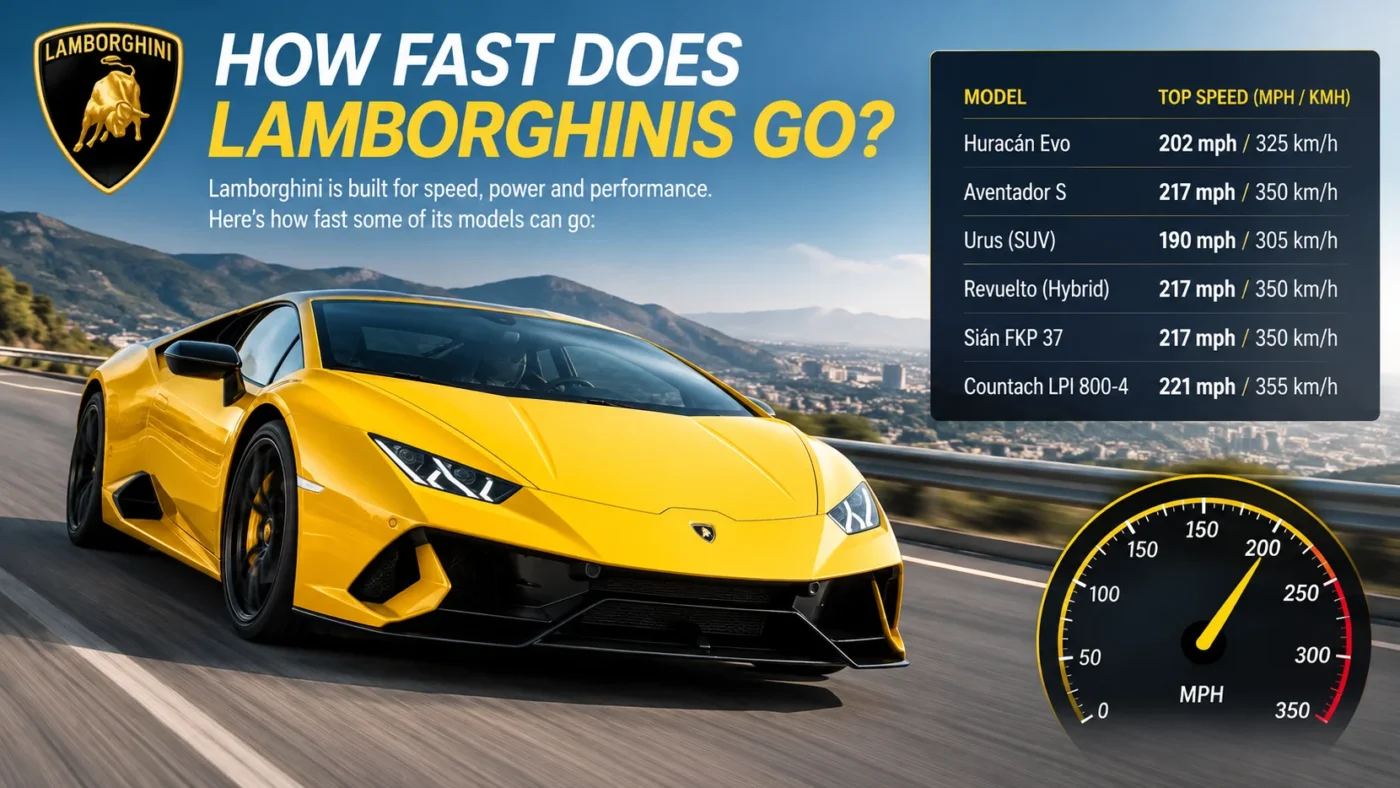
If you searched “how fast does lamborghinis go,” the short answer is that modern Lamborghini models can reach roughly 194 to more than 217 mph. The exact number depends on whether you mean the Revuelto, Temerario, Urus, or a rare older model. Acceleration matters too, because the quickest versions can reach highway speeds in only a few seconds.
Quick answer: Most modern Lamborghini road cars top out between about 194 and 217+ mph. The current Revuelto is rated above 350 km/h, or roughly 217 mph, while the Temerario reaches 343 km/h, about 213 mph. The Urus SE and Urus SE Performante reach 312 km/h (about 194 mph).
Lamborghini Speed at a Glance
| Model | Published top speed | Approx. mph | 0–62 mph |
|---|---|---|---|
| Revuelto | More than 350 km/h | 217+ mph | 2.5 sec |
| Revuelto SV | 348 km/h | 216 mph | 2.4 sec |
| Temerario | 343 km/h | 213 mph | 2.7 sec |
| Urus SE Performante | 312 km/h | 194 mph | 3.3 sec |
| Urus SE | 312 km/h | 194 mph | 3.4 sec |
Lamborghini publishes the Revuelto at more than 350 km/h and a 2.5-second 0-100 km/h run. The Temerario is listed at 343 km/h, while both versions of the latest Urus shown above reach 312 km/h. These are manufacturer specifications, so real results can change with road surface, tires, weather, vehicle setup, and testing method.
Key Takeaways
- A current Lamborghini supercar can exceed 210 mph.
- The Revuelto is officially rated above 350 km/h, or roughly 217 mph.
- The Temerario reaches 343 km/h, or about 213 mph.
- The Urus SE family reaches about 194 mph, despite its larger SUV body.
- Some discontinued and limited-production models have published figures around 221 mph.
- Top speed and 0–60 mph acceleration measure different parts of performance.
“How Fast Does Lamborghinis Go?” Current 2026 Models in MPH
The Revuelto sits at the top end of the regular current range, with Lamborghini publishing a maximum speed above 350 km/h. That converts to just over 217 mph, although the company presents the figure as a threshold rather than an exact maximum. Its hybrid system combines a naturally aspirated V12 with three electric motors for 1,015 CV.
Acceleration is equally striking. Lamborghini lists the Revuelto at 2.5 seconds from zero to 62 mph, while Car and Driver recorded a 2.2-second zero-to-60-mph result in its testing. The difference highlights why manufacturer and independent-test numbers should not always be treated as interchangeable.
The newer Temerario is slightly slower at maximum speed but exceptionally quick from a stop. Its official specification lists 343 km/h, or about 213 mph, with 0-62 mph taking 2.7 seconds. Car and Driver later recorded 0-60 mph in 2.1 seconds, showing how traction and test procedures can produce a quicker U.S.-style acceleration figure.
For perspective, Autovyra’s C8 Corvette ZR1 performance guide covers an American supercar with a claimed 233-mph track top speed. That comparison shows why raw top speed should not be the only measure of a car’s performance. Acceleration, braking, handling, aerodynamics, and intended use can matter as much as the largest number on the specification sheet.
How Fast Is the Lamborghini Urus?
The latest Urus models prove extreme speed isn’t limited to low two-seat supercars. The Urus SE reaches 312 km/h, or about 194 mph, and accelerates from zero to 62 mph in 3.4 seconds. Its plug-in hybrid system combines a twin-turbo V8 with an electric motor for 800 CV.
The newer Urus SE Performante keeps the same published 312 km/h maximum while cutting the zero-to-62 mph time to 3.3 seconds. Lamborghini lists output at 812 CV and has positioned the model as the performance-focused version of its hybrid Super SUV. That means the difference between the two is more about acceleration and dynamic tuning than a higher headline top speed.
A 194-mph SUV is still operating far beyond ordinary highway speeds. Its larger body, extra passenger room, and greater everyday usefulness make the number especially unusual compared with a traditional mid-engine exotic. Readers comparing different types of performance cars can also see Autovyra’s Lotus Emira buyer’s guide, where lighter weight and driver involvement matter more than chasing a 200-mph figure.
Which Current Lamborghini Is the Fastest?
This question became more complicated in August 2026 with the arrival of the Revuelto SV. Lamborghini describes the SV as its fastest production model, with 1,065 CV, 0-62 mph in 2.4 seconds, and a published maximum of 348 km/h. That works out to roughly 216 mph.
Lamborghini’s own published numbers include an interesting detail. The regular Revuelto page says its maximum is more than 350 km/h, while the Revuelto SV specification lists 348 km/h even though Lamborghini calls the SV its fastest production car. Those figures are better treated as manufacturer specifications produced under different model programs than as a direct one-mph head-to-head test.
For a shopper or enthusiast, that distinction matters less than it first appears. Both versions operate in the same extraordinary 215-plus-mph territory, while the SV adds more power and a more track-focused package. The practical takeaway is that Lamborghini’s flagship supercars are designed around performance far beyond anything usable on normal U.S. public roads.
What Is the Fastest Lamborghini Ever?
Historical rankings often put several rare or discontinued models at about 221 mph. An updated 2026 performance database lists the Countach LPI 800-4 and Aventador LP 780-4 Ultimae at 221 mph, placing them above the published maximums of today’s mainstream models. Other sources also place limited-production cars such as the Veneno in roughly the same 220-to-221-mph range.
That does not mean an older 221-mph model will automatically outrun a new hybrid flagship in every situation. Top speed measures the maximum velocity a vehicle can sustain under suitable conditions, while acceleration measures how rapidly it gets there. A modern car can have a slightly lower stated maximum yet be quicker through a quarter-mile, faster around a circuit, or more consistent during repeated hard driving.
The distinction also helps explain why horsepower alone does not determine the answer. Aerodynamic drag rises sharply as speed increases, so adding power becomes progressively less effective at the far end of the speedometer. Gear ratios, tires, cooling, stability, downforce, and electronic limits all influence what a manufacturer is willing to publish as the maximum.
Top Speed vs. 0–60 MPH: Which Number Matters More?
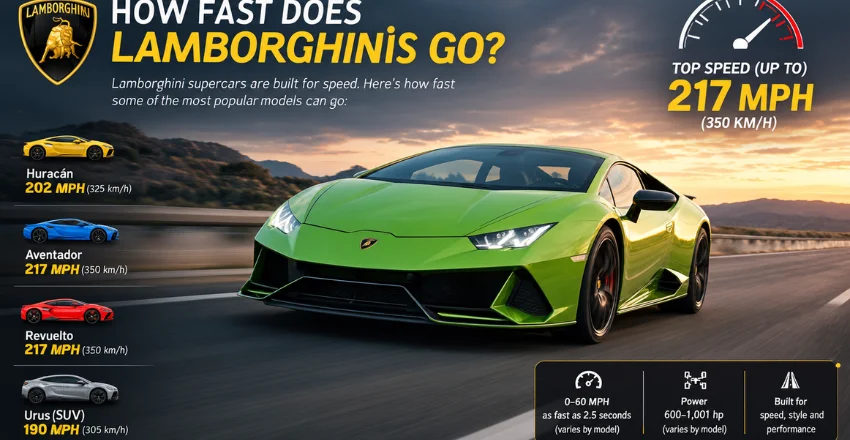
For everyday comparisons, zero-to-60 mph often tells you more about how brutally quick a car feels. A 210-mph car and a 220-mph car may never approach either maximum outside a closed course, but you can experience their launch performance at much lower speeds. Modern all-wheel-drive systems and electric torque also help today’s hybrids accelerate harder than many older exotics.
Top speed becomes a different engineering challenge. At 200 mph, aerodynamic drag and stability place huge demands on the body, tires, suspension, brakes, and cooling system. That is why a model designed for maximum track downforce does not always post the highest possible straight-line figure.
Autovyra’s 1999 Saleen S351 performance guide provides a useful historical contrast. Its period-tested 4.7-second zero-to-60-mph time was exceptional in the late 1990s, yet current exotic cars have reduced that figure by more than half. Looking across generations makes the progress in traction, power delivery, transmission speed, and tire technology easier to appreciate.
Can a Lamborghini Really Reach Its Published Top Speed?
A published top speed should be read as a performance specification, not something every owner will reproduce. Tires must be suitable for the speed, the car must be mechanically sound, and the road or track must be long enough to accelerate and slow down safely. Weather, elevation, wind, temperature, fuel load, and aerodynamic configuration can also influence the result.
Manufacturer numbers and magazine tests can differ because they may use different procedures. Lamborghini usually publishes zero-to-100-km/h figures, equivalent to zero to 62 mph, while U.S. publications often test zero to 60 mph instead. Some American tests also use rollout conventions, which can make the reported acceleration time lower.
Maximum-speed driving belongs on an appropriate closed course with professional safety controls. A car capable of more than 200 mph can cover a tremendous distance in only a few seconds, while braking from that speed requires far more room than an ordinary highway stop. The impressive part of these machines is not an invitation to test their limits on public roads.
Why Are Modern Lamborghini Models So Fast?
Power helps explain it, but modern performance depends on several systems working together. Hybrid motors can provide immediate torque before a gasoline engine reaches peak output, while fast dual-clutch transmissions reduce interruptions during shifts. All-wheel drive then helps convert that output into forward motion instead of tire spin.
Aerodynamics become increasingly important as speed rises. Designers must balance low drag with enough downforce to keep the car stable, while also routing air through radiators and brakes. Carbon-fiber structures help control weight and stiffness, giving the suspension a more stable platform during hard acceleration and cornering.
Tire technology places another boundary around usable performance. The tire has to withstand enormous rotational forces while maintaining grip and managing heat at speeds that would destroy an ordinary road tire. These factors explain why two cars with similar horsepower can have different acceleration times or maximum speeds.
The Bottom Line
Modern Lamborghini speed ranges from roughly 194 mph for the latest Urus hybrids to more than 217 mph for V12 flagship models. Some rare older cars are listed around 221 mph, while today’s hybrids can deliver extraordinary acceleration even when their published maximum is slightly lower. The result is a lineup where nearly every performance figure needs context about the exact model and test method.
For more U.S.-focused performance coverage, visit Autovyra’s Automobile section and compare different sports cars, supercars, engines, and ownership guides. Using the same source and test standard will give you a much more useful comparison than judging cars by one headline number. It also makes it easier to separate manufacturer claims from instrumented road-test results.
Frequently Asked Questions
What does “how fast does lamborghinis go” mean for current models?
Current models range from roughly 194 mph to more than 217 mph, based on Lamborghini’s published figures. The Urus SE sits near the lower end at about 194 mph, while the Revuelto reaches about 217 mph. The Temerario falls between them at approximately 213 mph.
Can a Lamborghini go 200 mph?
Yes, several Lamborghini supercars have manufacturer-rated top speeds above 200 mph. The current Revuelto and Temerario both clear that mark, while the Urus SE remains slightly below it at approximately 194 mph. Whether a car can reproduce the figure depends on its condition, specification, tires, and controlled testing environment.
What is the fastest Lamborghini from 0 to 60 mph?
Independent testing can produce different answers as new models arrive. Car and Driver recorded the Temerario at 2.1 seconds to 60 mph and the Revuelto at 2.2 seconds in its respective tests. Manufacturer figures use zero to 62 mph instead, so compare results from the same testing method whenever possible.
Is 221 mph the highest Lamborghini top speed?
Several production or limited-production models are listed around 221 mph in current performance databases. That figure is associated with cars such as the Countach LPI 800-4 and Aventador Ultimae, although published rankings vary slightly for some rare models. The safest comparison is to identify the exact model and source rather than assuming every historical ranking uses identical testing standards.