

The best-rated auto insurance company depends on what you value most. Amica, Travelers, GEICO, Nationwide, Progressive, Acuity, and USAA all perform well in major 2026 evaluations, but they win for different reasons. Compare several quotes, review complaint and claims data, and make sure each policy offers the same coverage limits before choosing.
| Quick Answer | What to Know |
|---|---|
| Best Rated Auto Insurance | The best company depends on your driving profile, location, coverage needs, and available discounts. |
| Strong all-around options | Amica and Travelers |
| Strong savings and discounts | GEICO |
| Strong customer satisfaction | Acuity and Nationwide |
| Strong optional coverage | Progressive |
| Strong military-family option | USAA |
| Best shopping method | Compare equal coverage quotes from at least three insurers. |
No company holds a universal number-one position. NerdWallet named Amica its best overall choice in July 2026, while Insurance.com placed Travelers first in its January 2026 national-carrier ranking. Those different results show why you should examine the method behind every rating.
Our Verdict on the Best Rated Auto Insurance Companies
Amica is a strong starting point for drivers who value an all-around mix of financial stability, customer experience, and coverage. Travelers deserve equal consideration when price and claims service matter. GEICO may suit drivers focused on discounts, while Progressive offers a broad selection of policy add-ons.
Your own winner may change after quotes are calculated. Location, age, driving history, vehicle, annual mileage, credit-based insurance score where permitted, and selected limits can all affect pricing.
Comparison of Seven Highly Rated Insurers
| Insurer | Best fit | Main strength | Possible drawback |
| Amica | Drivers seeking balanced quality | Strong overall ratings and customer experience | May not be the lowest-priced option for every profile |
| Travelers | Drivers seeking value and service | Competitive rates and strong national rankings | Availability and pricing vary by state |
| GEICO | Discount-focused shoppers | Numerous discounts and competitive pricing | Fewer specialized options than some competitors |
| Nationwide | Drivers focused on retention and trust | Strong renewal intent in surveyed customers | Not always the cheapest quote |
| Progressive | Drivers wanting policy customization | Broad selection of optional protections | Rates can vary sharply by driver |
| Acuity | Drivers prioritizing low complaint levels | Strong customer-experience indicators | Limited geographic availability |
| USAA | Eligible military families | Strong customer satisfaction and competitive rates | Restricted eligibility |
These recommendations combine current editorial rankings rather than treating one score as final. NerdWallet’s July 2026 analysis highlighted Amica, GEICO, Travelers, Acuity, and Progressive for separate strengths. Insurance.com’s ranking placed Travelers, GEICO, and Nationwide in its top three.
1. Amica: Best All-Around Starting Point

NerdWallet selected Amica as its best overall company for July 2026. Its analysis considered factors such as financial strength, customer experience, digital features, discounts, and available protection.
Pros
- Strong all-around editorial rating
- Good choice for service-focused drivers
- Established financial-strength record
Cons
- Your quote may not be the cheapest
- Product availability can differ by location
Amica belongs on your quote list when service quality matters as much as price. Still, compare its estimate against at least two other providers.
2. Travelers: Best Blend of Price and Service
Insurance.com ranked Travelers first among national companies for 2026. The publication cited its rates, satisfaction results, policy offerings, claims handling, digital experience, financial strength, and complaint record. NerdWallet also identified Travelers as its budget-focused choice among the companies in its analysis.
Pros
- Strong value indicators
- Wide policy selection
- Favorable claims and service results
Cons
- The lowest average rate may not apply to your profile
- Options can vary by state
Travelers is a practical first quote for drivers who want balanced pricing without choosing solely on cost.
3. GEICO: Best for Discounts and Broad Availability
GEICO ranked second in both the NerdWallet and Insurance.com evaluations reviewed for this guide. NerdWallet highlighted its discount opportunities, while Insurance.com noted competitive rates and strong survey results.
Pros
- Many discount opportunities
- Easy online policy management
- Competitive quotes for many driver groups
Cons
- Local service experiences may differ
- Specialized endorsements may be more limited
GEICO can be a good fit when you prefer digital account management or qualify for several discounts.
4. Nationwide: Best for Trust and Renewal Intent
Nationwide placed third in Insurance.com’s national ranking. The company received strong trust results, and 94% of surveyed customers said they planned to renew.
Pros
- Strong customer-retention indicators
- Below-average rates in the cited analysis
- Broad national presence
Cons
- Another carrier may offer a lower local quote
- Discounts and features differ by state
Nationwide deserves attention when long-term service and policy stability matter to you.
5. Progressive: Best for Optional Coverage
Progressive stood out in NerdWallet’s evaluation for coverage add-ons. The cited examples included vet reimbursement and minor dent repair protection. Insurance.com also reported a low complaint ratio and a strong financial stability rating.
Pros
- Many optional protections
- Useful tools for comparing policy choices
- Suitable for drivers with specific coverage needs
Cons
- Pricing may be above average for certain profiles
- Extra features can raise the premium
Progressive is worth comparing when a basic policy won’t meet your needs.
6. Acuity: Best for Low Complaint Levels
NerdWallet selected Acuity as its customer-satisfaction choice and reported that it received the fewest complaints relative to its business volume among the top companies reviewed.
Pros
- Low complaint indicators
- Strong customer-experience rating
- Good option for service-focused buyers
Cons
- Not available nationwide
- Fewer consumers may be familiar with the brand
Check eligibility in your state before spending time on a detailed comparison.
7. USAA: Best for Eligible Military Families
USAA often receives strong satisfaction and pricing results, but membership is generally limited to eligible military members, veterans, and their families. Insurance.com excluded it from its main national ranking because of that restricted eligibility, although the company received a high score in its data.
Pros
- Strong satisfaction results
- Competitive pricing for many eligible members
- Services designed for military households
Cons
- Not available to most drivers
- Membership rules apply
Eligible households should include USAA in their comparison, but they should still collect competing quotes.
How to Find the Best Rated Auto Insurance for You
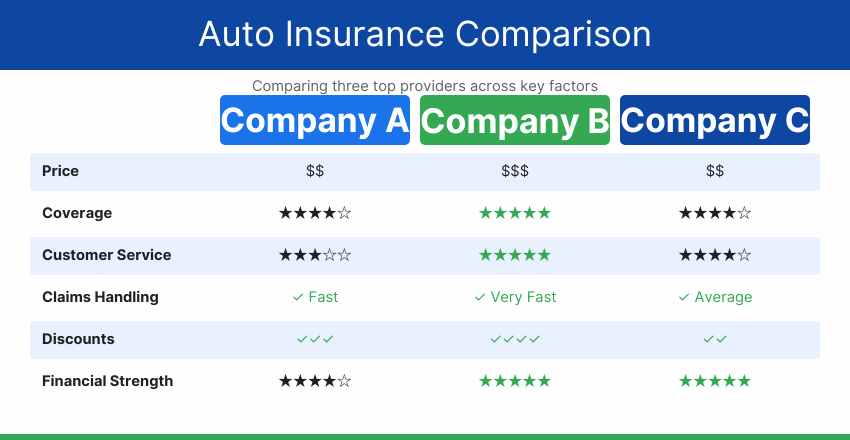
A high editorial score is useful, but it shouldn’t replace personal quote shopping. Use the following process to compare companies fairly.
- Choose your coverage limits first. Decide how much liability, collision, comprehensive, uninsured-motorist, medical, and optional protection you need.
- Request matching quotes. Use the same limits, deductibles, drivers, vehicles, and annual mileage for every estimate.
- Check complaint information. A cheap policy can become costly if claims service is poor. Review complaint data from your state insurance department and the National Association of Insurance Commissioners.
- Review financial strength. Ratings from agencies such as AM Best can help indicate an insurer’s ability to meet policy obligations.
- Study the exclusions. Roadside assistance, rental reimbursement, new-car replacement, accident forgiveness, and rideshare coverage may have limits that aren’t obvious in an advertisement.
- Ask about every discount. Common opportunities include multipolicy, multivehicle, safe-driver, good-student, low-mileage, automatic-payment, and vehicle-safety discounts.
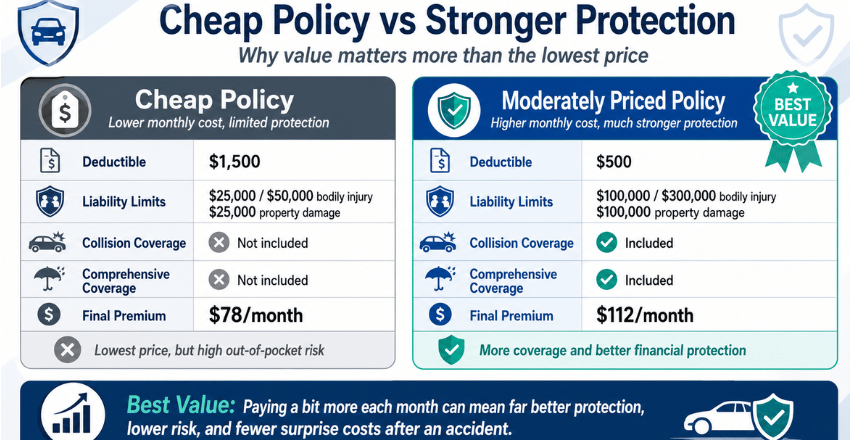
- Compare the final annual cost. A low monthly payment can hide fees or a different payment schedule. Compare the full premium.
For more plain-language coverage guidance, visit Autovyra’s auto insurance resource section. You can also review its vehicle-maintenance guides because your vehicle’s condition, use, and repair needs affect ownership costs. Autovyra explains its research and editorial approach on the About Autovyra page.
What Ratings Should You Trust?
Look for rankings that explain their scoring method. A useful review should consider several factors, such as:
- Customer complaints
- Claims satisfaction
- Financial strength
- Average premiums
- Coverage choices
- Discounts
- Digital tools
- Policyholder surveys
A market-share list tells you which companies are large, not which one will serve you best. State Farm, Progressive, GEICO, and Allstate hold substantial shares of the U.S. market, but popularity alone doesn’t measure price or customer fit.
Independent studies can also disagree. One publisher may give more weight to price, while another prioritizes complaints or satisfaction. Treat each score as a starting point.
How Many Quotes Should You Compare?

Collect at least three comparable quotes. Five may be worthwhile when you have a young driver, an accident, a ticket, a lapse in coverage, poor credit where insurance scoring is permitted, or a high-value vehicle.
Don’t assume your current provider remains competitive. Insurers use different rating models, and your lowest-priced option can change after a move, vehicle purchase, marriage, claim, or policy renewal.
Compare again before each renewal or after a major life change. Keep the coverage identical so you don’t mistake reduced protection for savings.
Frequently Asked Questions
There isn’t one winner for every driver. Amica and Travelers are strong all-around starting points based on current 2026 evaluations. GEICO, Nationwide, Progressive, Acuity, and USAA may be better for specific needs.
No. Ratings often combine price, claims service, financial strength, complaints, coverage, and customer surveys. Your premium is based on personal and local factors.
Compare both when possible. National companies may offer broader digital tools and availability. Regional insurers can provide strong local service and competitive pricing.
Start with coverage. A cheaper quote isn’t a fair deal when it has lower liability limits, higher deductibles, or fewer protections.
Review your options before renewal and after major changes. These include moving, replacing a vehicle, adding a driver, getting married, or experiencing a large rate increase.
Reviews can reveal service patterns, but individual stories don’t show the full picture. Combine them with complaint data, financial-strength ratings, coverage details, and several quotes.
Final Recommendation
For the best-rated auto insurance, start with Amica and Travelers for balanced quality. Add GEICO when discounts matter, Progressive when you need additional coverage choices, and Nationwide when customer retention and trust are priorities. Consider Acuity where available and USAA when eligible.
Then compare matching quotes with the same limits and deductibles. The right policy is the one that provides suitable protection, dependable claims support, and a competitive price for your specific driver profile.