
Car ramps give DIY owners a simple way to create extra working room beneath a vehicle for jobs such as oil changes and underbody inspections. The right set must fit your vehicle’s weight, tires, ground clearance, and intended repair. Choosing by price alone can leave you with a ramp that is too steep, too narrow, or too lightly rated. More from us: Are Car Dealerships Open on Sundays.
| Car ramps | Why it matters |
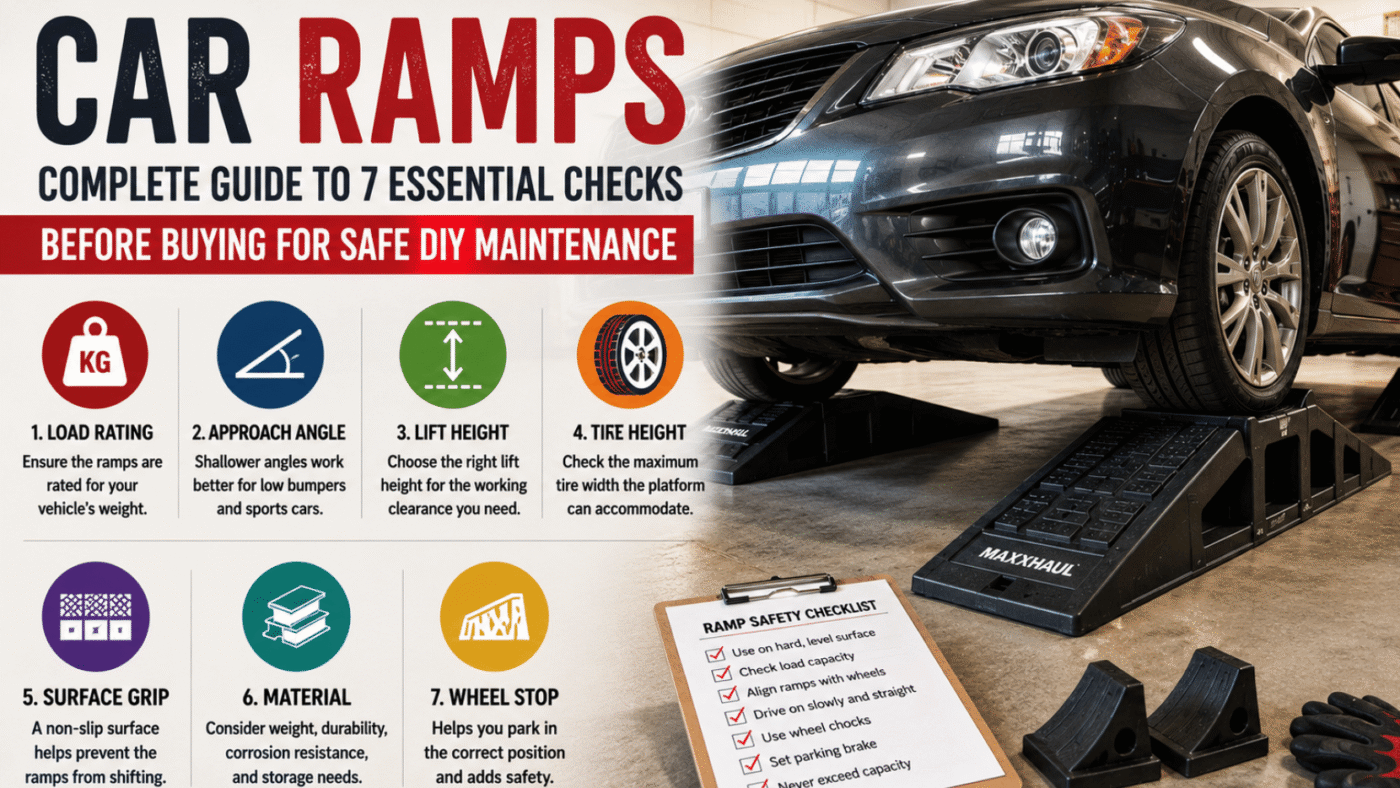
| Load rating | The pair must be rated appropriately for the vehicle |
| Approach angle | A steep incline may contact a low bumper or splitter |
| Lift height | Determines how much working clearance you gain |
| Tire width | Tires need to sit correctly on the platform |
| Surface grip | Helps keep the ramp from shifting during loading |
| Material | Affects weight, storage, corrosion resistance, and durability |
| Wheel stop | Helps identify the intended stopping position |
What Are Car Ramps Used For?

A service ramp raises one end of a vehicle by allowing its tires to roll onto an elevated platform. That can provide access for routine work without locating a lifting point and raising each side separately.
Common uses include:
- Changing engine oil and filters
- Inspecting an exhaust system
- Checking for leaks
- Examining underbody components
- Reaching splash shields or drain plugs
- Performing cleaning or corrosion inspections
They aren’t suitable for every repair. A job that requires a wheel to leave the ground, such as many brake or suspension tasks, calls for a different lifting method.
For broader ownership, maintenance, and vehicle information, browse AutoVyra’s Automobile guides.
Things to Check Before Choosing a Set
Start With the Load Rating
Capacity is the first specification to verify. Do not assume a high number printed on a product means every vehicle below that weight is automatically compatible. Manufacturers can describe capacity in different ways, so read the product instructions and rating carefully.
For example, current products show substantial differences. Race Ramps lists models with specific per-ramp and total capacities, while MaxxHaul publishes both total and per-ramp ratings for its low-profile model.
Check your vehicle’s specifications before buying. When the rating language is unclear, use the manufacturer’s documentation rather than guessing.
Measure Your Approach Clearance
Ground clearance alone doesn’t tell you whether the front of your vehicle will make it onto a ramp. The approach angle matters because the bumper, splitter, air dam, or other bodywork reaches the incline before the tires climb it. Lower cars generally need a longer, shallower design.
Car and Driver’s 2026 testing illustrates the difference. The Race Ramps RR-56 test model used a 10.8-degree incline, while the tested Rhino Ramps had a 17-degree incline that the publication considered less suitable for lower-profile cars. If you own a sports car or modified vehicle, compare the published angle and dimensions with the front overhang before ordering.
Decide How Much Lift You Need
A shallow incline solves one problem but can create another: limited working room. Low-profile designs may raise a vehicle only a few inches. Maxx Haul, for example, lists a 2.5-inch lift height for one of its low-profile models. Other service designs raise the tires considerably higher.
Think about the actual task. For an oil change, you need enough room to reach the drain plug, filter, fasteners, and any undertray that must be removed. Extra height that you don’t need can make a product longer, heavier, steeper, or harder to store.
Check Tire Width and Platform Size
Wide tires can rule out an otherwise suitable model. Look for the manufacturer’s maximum tire width or usable platform width. The tire should sit where the product manufacturer intends, rather than hanging over an edge.
Width deserves extra attention for trucks, SUVs, performance cars, and vehicles with aftermarket wheels. Car and Driver highlighted a 13-inch-wide base as one reason its tested Rhino Ramp worked well for many trucks. By contrast, its low-profile recommendation used a 12-inch ramp width.
Compare Materials Based on How You Work
You’ll commonly find plastic or composite, steel, aluminum, and specialized foam designs. Plastic models can be relatively light and easy to nest for storage. Steel designs may be heavier and more prone to corrosion, but they can also be sturdy and compact. Aluminum can reduce weight compared with some steel constructions, although pricing may be higher.
High-density foam is another option. In its 2026 test, Car and Driver measured a pair of 56-inch Race Ramps at about 20 pounds while noting their larger storage footprint. There isn’t one material that suits every garage. Consider how often you use the equipment, where you store it, and whether you need to move it frequently.
Low-Profile, Standard, or Heavy-Duty: Which Type Fits?

| Type | Best suited to | Main advantage | Main trade-off |
| Low-profile | Sports cars and low bumpers | Shallow entry angle | May provide less lift or require more length |
| Standard service | Typical cars and crossovers | Balance of height, size, and price | May be too steep for low vehicles |
| Heavy-duty | Trucks and heavier vehicles | Higher available capacity | Often larger or heavier |
| Lightweight foam | Frequent home use and low cars | Easy to carry | Can cost more and take more storage space |
Verdict: For most owners, the best choice isn’t the model with the largest advertised capacity. Choose the smallest practical design that comfortably meets your vehicle’s weight, tire, clearance, and working-height requirements. Low-clearance cars benefit most from a shallow approach, while trucks demand closer attention to capacity and platform width.
AutoVyra’s vehicle buying and ownership coverage can help you check related specifications when comparing equipment for different vehicle types.
How to Use Vehicle Ramps More Safely
The equipment is only one part of safe vehicle support.
Government product-safety guidance recommends using portable vehicle ramps in pairs on a hard, level surface, checking their load capacity and tire compatibility, aligning them with the wheels, and driving onto them slowly. It also recommends securing against unwanted movement.
A sensible setup process is
- Read the instructions supplied with your specific model.
- Inspect the equipment for damage before use.
- Park on a hard, clean, level surface.
- Position both units straight and square with the tires.
- Have another person guide you when possible.
- Drive forward slowly and smoothly.
- Stop at the manufacturer’s intended platform position.
- Put an automatic transmission in Park or a manual transmission as directed by the vehicle and equipment instructions.
- Apply the parking brake when appropriate.
- Chock the wheels remaining on the ground.
- Confirm the vehicle and equipment are stable before going underneath.
Sealey’s current ramp instructions likewise call for a clean, level surface, a spotter during loading, the parking brake, and wheel chocks behind the wheels remaining on the ground. Never exceed the manufacturer’s stated capacity or improvise around damaged equipment.
Are Ramps Better Than a Floor Jack?
They solve different problems. For routine work where the wheels can remain loaded, driving onto a platform can be convenient. You avoid lifting the vehicle one side at a time, and the tires remain supported.
A floor jack and correctly positioned support stands are more versatile when wheels need to come off or suspension components need to hang free. So the better question is, “Which method fits the repair?” Use the vehicle manufacturer’s service information and the lifting equipment instructions for the specific job. Don’t treat a hydraulic jack alone as support while you work beneath a vehicle.
Common Buying Mistakes

A high capacity number can distract from specifications that matter just as much.
Avoid these errors:
- Buying before measuring front clearance
- Ignoring maximum tire width
- Choosing too little lift for the planned repair
- Assuming every capacity label is expressed the same way
- Using a steep model with low bodywork
- Prioritizing compact storage over vehicle fit
- Using equipment on gravel, dirt, slopes, or unstable surfaces when the manufacturer requires a hard level floor
- Continuing to use cracked, bent, heavily corroded, or otherwise damaged equipment
A few minutes spent checking dimensions can prevent an expensive return or a dangerous mismatch.
Conclusion
Choosing the right car ramps is about more than finding the lowest price. A well-matched set should support your vehicle’s weight, fit its tire size, provide the right lift height, and offer an approach angle that prevents damage to the low bodywork.
Taking a few minutes to compare these specifications before buying can make routine maintenance safer and more convenient. Whether you perform occasional oil changes or regular DIY servicing, investing in quality car ramps that suit your vehicle and using them correctly on a hard, level surface with proper wheel chocks will help you work with greater confidence and safety for years to come.
Please visit our Vehicle Maintenance Category.
Frequently Asked Questions
They can be suitable when the product is correctly rated and used according to its instructions on a hard, level surface. Secure the vehicle against movement and inspect the equipment before each use.
Use a model whose published rating is appropriate for your vehicle and how the manufacturer defines that rating. Check the vehicle specifications and the ramp manual rather than relying on assumptions about total vehicle weight.
Often, yes. The front overhang and approach angle determine whether the bumper or splitter contacts the incline before the tire begins climbing. Compare the ramp angle and dimensions with your vehicle.
Enough to safely reach the components involved in your planned job. A small lift may be useful for inspection or gaining jack access, while other maintenance tasks require more working clearance.
Yes, wheels remaining on the ground should be secured as instructed. Product-safety guidance specifically recommends chocking them to reduce the risk of the vehicle rolling.
The Bottom Line
The right vehicle-support equipment should fit the car before it fits the budget. Check capacity, tire width, approach angle, lift height, construction, storage needs, and manufacturer guidance together. For a low sports car, a shallow entry may matter most.
For a truck, capacity and platform width can become the deciding factors. For routine home maintenance, ease of setup and storage may matter nearly as much. Before buying, measure your vehicle and compare those numbers with the manufacturer’s published specifications. Then use the equipment exactly as directed every time.