
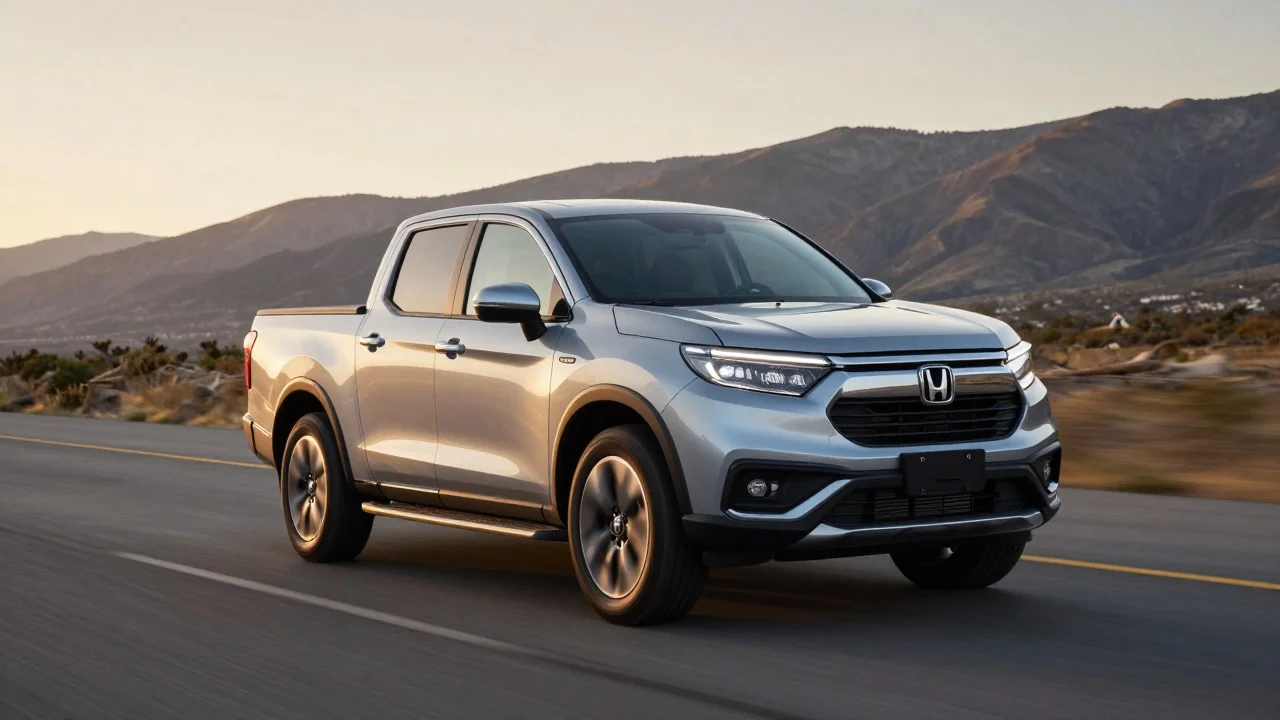
The Honda Ridgeline MPG numbers are straightforward once you separate the TrailSport from the rest of the lineup. For 2026, most Ridgeline trims are EPA-rated at 18 mpg city, 24 mpg highway, and 21 mpg combined, while the TrailSport configurations lose 1 mpg on the highway and combined cycle. Older Ridgelines can have different ratings because Honda previously offered two-wheel drive, different transmissions, and a different mix of trims. Also worth reading: VSA Light.
Direct answer: The 2026 Honda Ridgeline gets an EPA-rated 18 mpg city, 24 highway, and 21 combined in Sport, RTL, Black Edition, and Black Edition Two-Tone trims. TrailSport and TrailSport+HPD Wheels are rated 18/23/20. All use AWD, a 3.5-liter V6, a nine-speed automatic, and regular unleaded.
2026 Honda Ridgeline MPG by Trim
Honda currently sells every 2026 Ridgeline with its i-VTM4 all-wheel-drive system, 3.5-liter V6, and nine-speed automatic transmission. The engine produces 280 horsepower, while every trim also uses a 19.5-gallon fuel tank and regular unleaded gasoline. The important fuel-economy distinction is therefore not engine choice or drivetrain choice, but whether you buy one of the TrailSport configurations.
| 2026 Ridgeline trim/configuration | EPA city MPG | EPA highway MPG | EPA combined MPG |
|---|---|---|---|
| Sport | 18 | 24 | 21 |
| RTL | 18 | 24 | 21 |
| TrailSport | 18 | 23 | 20 |
| TrailSport+HPD Wheels | 18 | 23 | 20 |
| Black Edition | 18 | 24 | 21 |
| Black Edition Two-Tone | 18 | 24 | 21 |
Honda’s current specification sheet confirms these ratings for the complete 2026 lineup. Sport, RTL, Black Edition, and Black Edition Two-Tone therefore share the best EPA combined rating at 21 mpg. TrailSport and TrailSport+HPD Wheels come in at 20 mpg combined instead.
Why Does the Ridgeline TrailSport Get Lower MPG?
The TrailSport is designed around additional off-pavement ability rather than maximum fuel economy. Honda gives it all-terrain tires and an off-road-tuned suspension, and those tires create a different rolling-resistance and road-use profile than the all-season tires fitted to the other trims. Honda’s published ratings show the result clearly: city mileage remains 18 mpg, while highway mileage falls from 24 to 23 mpg and combined mileage falls from 21 to 20.
That difference is relatively small for an owner who does normal annual mileage. At 12,000 miles per year, a vehicle averaging the EPA combined 21 mpg would use about 571 gallons, while one averaging 20 mpg would use about 600 gallons. The difference is roughly 29 gallons annually, so you can multiply that number by your local gasoline price to estimate the financial cost of choosing TrailSport capability.
The decision should therefore come down to how you actually use the truck. Drivers who stay mostly on pavement have little fuel-economy reason to choose the TrailSport, while buyers who value its all-terrain tires and off-road setup may consider the 1-mpg combined penalty modest. If tires are part of your decision, AutoVyra’s guide to the best all-season tires provides more context on choosing tires for traction, comfort, and everyday driving.
Honda Ridgeline MPG by Model Year

Current figures should not be applied automatically to every used Ridgeline. Honda has changed the available drivetrains, transmissions, and trim structure during the second generation, so a used truck’s model year and drivetrain can materially change its EPA label. The table below summarizes the official ratings for 2017 through 2026 and identifies which configurations those figures apply to.
| Model year | Configuration or trims | EPA city/highway/combined |
|---|---|---|
| 2026 | Sport, RTL, Black Edition, Black Edition Two-Tone AWD | 18/24/21 |
| 2026 | TrailSport, TrailSport+HPD Wheels AWD | 18/23/20 |
| 2025 | Sport/Sport+, RTL/RTL+, Black Edition AWD | 18/24/21 |
| 2025 | TrailSport/TrailSport+ AWD | 18/23/20 |
| 2024 | Sport, RTL, Black Edition AWD | 18/24/21 |
| 2024 | TrailSport AWD | 18/23/20 |
| 2021–2023 | Sport, RTL, RTL-E, Black Edition AWD | 18/24/21 |
| 2020 | Sport and RTL 2WD | 19/26/22 |
| 2020 | Sport, RTL, RTL-E, Black Edition AWD | 19/24/21 |
| 2018–2019 | Eligible 2WD trims | 19/26/22 |
| 2018–2019 | Eligible AWD trims | 18/25/21 |
| 2017 | Eligible 2WD trims | 19/26/22 |
| 2017 | Eligible AWD trims | 18/25/21 |
The 2024 model year is the major dividing line for today’s TrailSport comparison. Honda introduced the TrailSport configuration with its 18/23/20 rating, while the Sport, RTL, and Black Edition remained at 18/24/21. The same basic split continues through the 2025 and 2026 model years.
From 2021 through 2023, the equation was simpler because the listed Sport, RTL, RTL-E, and Black Edition versions all used AWD and carried the same 18/24/21 EPA rating. The 2020 model is more complicated because Honda still offered two-wheel-drive Sport and RTL versions rated at 19/26/22, while the AWD models were rated at 19/24/21. That makes drivetrain verification especially important when you are evaluating a used 2020 Ridgeline.
The 2017 through 2019 trucks used a six-speed automatic and could also be found in two-wheel-drive or AWD form, depending on trim and model year. Eligible 2WD configurations were generally rated at 19/26/22, while eligible AWD configurations were rated at 18/25/21. A used listing that simply says “Ridgeline MPG” without identifying drivetrain can therefore be misleading for these years.
Which Ridgeline Gets the Best Gas Mileage?
Among current 2026 models, there is no fuel-economy winner between the Sport, RTL, Black Edition, and Black Edition Two-Tone because all four share the same 18/24/21 EPA rating. Choosing a more expensive trim does not automatically cost you fuel economy as long as you stay outside the TrailSport configurations. That means equipment, comfort, appearance, and price can determine the choice without an MPG trade-off between those four versions.
Used shoppers can technically find better EPA highway numbers in older two-wheel-drive Ridgelines. The 2017–2020 2WD versions listed above reach 26 mpg highway and 22 mpg combined, although availability depends on the specific year and trim. Buyers in snowier areas or those who specifically want Honda’s AWD system may decide that the extra traction matters more than the small economy advantage.
EPA MPG vs. Real-World Ridgeline Fuel Economy
EPA numbers are best used as standardized comparison figures rather than a promise of what every owner will see. Speed, winter temperatures, traffic, terrain, tire pressure, payload, towing, idling, and driving style can move real-world consumption significantly above or below the label. That is particularly important with a pickup because adding cargo or a trailer changes the work the engine must do.
Independent testing shows how broad that variation can be. AAA reported 21 mpg during a week in a 2026 Ridgeline TrailSport with mixed city and highway driving, slightly beating its 20-mpg EPA combined rating. The Drive, by contrast, saw 16.7 mpg over 404 miles in very cold Minnesota conditions. Car and Driver has also recorded 28 mpg on its 75-mph highway fuel-economy test in a Ridgeline, demonstrating that steady highway use can produce a different result from short trips or winter driving.
Those numbers should not replace the EPA label when comparing trims. Instead, they show why two owners with identical trucks can report noticeably different mileage without either number necessarily being wrong. For shopping purposes, start with the official city/highway/combined rating and then adjust your expectations for your own route, climate, loads, and driving habits.
How Far Can a Ridgeline Go on a Tank?
Every 2026 Ridgeline has a 19.5-gallon fuel tank, so simple EPA arithmetic gives a theoretical combined-distance figure of about 410 miles at 21 mpg or 390 miles at 20 mpg. Those figures assume every gallon is used and the truck actually achieves the EPA combined rating, so they should not be treated as guaranteed driving range. Real fill-ups occur before the tank is completely empty, and weather, traffic, towing, and speed can change consumption.
Highway-heavy trips can produce a larger theoretical number because the EPA highway ratings are 24 mpg for most trims and 23 mpg for TrailSport versions. City-heavy ownership works in the other direction because every 2026 version is rated at 18 mpg city. Planning fuel stops from the truck’s actual trip computer and fuel gauge is safer than relying on a maximum calculated range.
How to Improve Your Ridgeline’s Real-World MPG
You cannot change the truck’s EPA rating, but you can influence how closely your real-world results track it. Highway speed is especially important because aerodynamic drag rises rapidly as speed increases, while extra cargo, roof-mounted equipment, underinflated tires, and repeated hard acceleration also require more fuel. Short cold-weather trips can be particularly inefficient because the engine spends more time reaching normal operating temperature.
Useful habits include:
- Keep tires at the pressure listed on the vehicle placard.
- Remove unnecessary cargo when you do not need it.
- Avoid extended idling.
- Accelerate progressively instead of repeatedly using full throttle.
- Use steady highway speeds where conditions allow.
- Keep up with engine, transmission, and drivetrain maintenance.
- Expect fuel economy to fall when towing or carrying heavy loads.
- Check alignment and tire condition if mileage falls unexpectedly.
Tires deserve special attention because the current TrailSport itself demonstrates that tire choice and intended use can come with a measurable change in EPA highway efficiency. Choosing a replacement tire solely for low rolling resistance can be a mistake if it sacrifices the wet, winter, load, or durability performance your truck requires. AutoVyra’s all-season tire guide can help owners compare those competing priorities.
Is the Ridgeline Fuel-Efficient for a Truck?
The Ridgeline’s current 20–21 mpg combined rating is respectable for a naturally aspirated V6 AWD midsize pickup, but fuel economy is not its strongest selling point. Its appeal is the combination of a truck bed, 5,000-pound towing capacity, standard AWD, independent suspension, a five-passenger cabin, and car-like road manners. Buyers who place fuel consumption above those qualities can find substantially more efficient alternatives, especially hybrids.
For example, AutoVyra’s 2023 Ford Maverick review covers a used compact pickup whose hybrid version carries a 40/33/37 mpg EPA rating, although its size and capability are different from the Ridgeline’s. Drivers who do not truly need a pickup bed can also explore AutoVyra’s best-MPG SUV guide for more efficient crossover options. The better vehicle depends on whether reducing fuel use matters more than the Ridgeline’s space, AWD system, ride comfort, and 5,000-pound towing capability.
Honda shoppers can also compare the Ridgeline with AutoVyra’s Honda Passport review. The Passport uses a related naturally aspirated V6 and standard AWD approach but packages it as a midsize SUV rather than a pickup. Comparing the two helps clarify whether you actually need the Ridgeline’s bed or would rather have an enclosed cargo area.
The Bottom Line
For 2026, Honda Ridgeline MPG comes down to two official EPA ratings. Sport, RTL, Black Edition, and Black Edition Two-Tone deliver 18/24/21 mpg, while TrailSport and TrailSport+HPD Wheels deliver 18/23/20. That makes the standard-road trims the efficiency choice, although the TrailSport penalty is only 1 mpg on the highway and combined cycle.
Used buyers need to look beyond the model name because older Ridgelines were sold with different drivetrain and transmission combinations. Verify the year, trim, and whether the truck is 2WD or AWD before comparing EPA mileage, particularly on 2017–2020 models. For any truck you are considering, the EPA figure is the starting point; your actual result will depend on how, where, and how heavily you drive it.
Frequently Asked Questions
Most 2026 trims are EPA-rated at 18 mpg city, 24 mpg highway, and 21 mpg combined. That applies to the Sport, RTL, Black Edition, and Black Edition Two-Tone. TrailSport and TrailSport+HPD Wheels are rated at 18/23/20.
Yes. For the 2026 model year, TrailSport configurations get the same 18-mpg city rating but drop from 24 to 23 mpg highway and from 21 to 20 mpg combined. The trim also uses all-terrain tires and an off-road-oriented setup.
Sport, RTL, Black Edition, and Black Edition Two-Tone tie for the best official 2026 fuel economy at 18/24/21. There is therefore no MPG advantage to choosing Sport over RTL or Black Edition. TrailSport models are the only current configurations rated lower.
No. Honda specifies regular unleaded fuel for the current 2026 Ridgeline lineup. The same official specification table lists a 19.5-gallon tank for every trim.
Several 2017–2020 two-wheel-drive configurations were rated at 19 mpg city, 26 highway, and 22 combined, giving them a higher combined rating than current AWD Ridgelines. The exact eligible trims changed by year, so confirm the drivetrain before relying on a used listing’s MPG figure. AWD trucks from those years carry different ratings.