

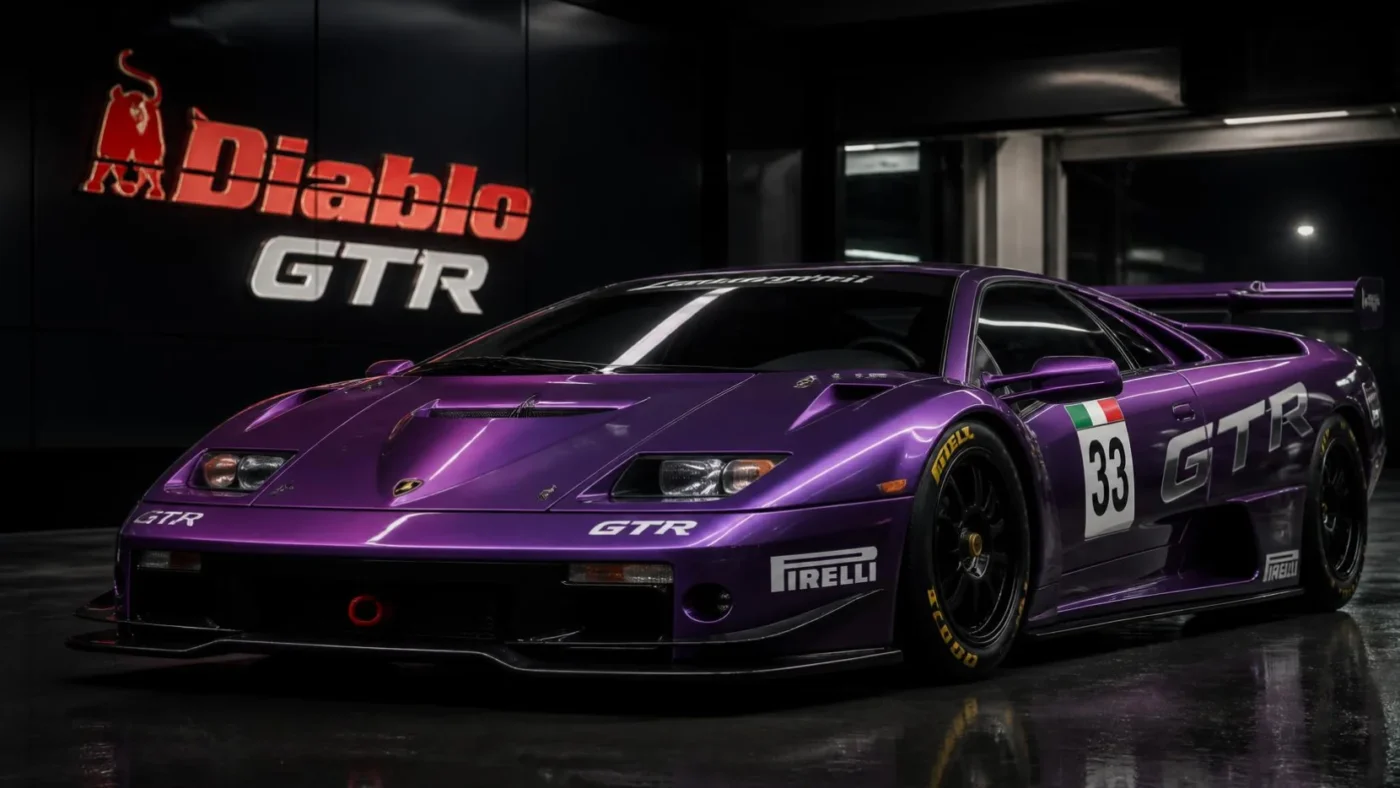
The Diablo Lamborghini GTR was Lamborghini’s factory-built customer racer based on the already extreme Diablo GT. It arrived for the 2000 season with a 6.0-liter V12, rear-wheel drive, and a stripped competition cabin. For collectors, rarity, race history, and U.S. status now matter as much as speed.
| Key fact | Detail |
| Model | Lamborghini Diablo GTR |
| Debut | 1999 Bologna Motor Show |
| Purpose | Track-only customer race car |
| Engine | 5,992 cc naturally aspirated V12 |
| Output | About 590 PS |
| Transmission | Five-speed manual |
| Drivetrain | Rear-wheel drive |
| Published weight | About 3,075 lb |
| Numbered production | 30 competition cars |
| Published top speed | About 210–216 mph, depending on source |
The Lamborghini Diablo GTR was the track-only evolution of the Diablo GT, built for Lamborghini’s one-make racing series. It combined a 590-PS V12 with lower weight, race suspension, center-lock magnesium wheels, air jacks, and a single-seat cabin. Major auction sources consistently document 30 numbered competition cars.
Key takeaways
- The GTR used the Diablo GT as its base and was rebuilt for competition.
- Its 6.0-liter V12 produced about 590 PS and drove the rear wheels.
- Major auction houses document a numbered run of 30 cars.
- Published top-speed figures range from about 210 to 216 mph.
- Auction history shows high six-figure results and seven-figure estimates.
- U.S. federal import rules now treat 2000-built examples differently because of their age.
What is the Lamborghini Diablo GTR?

Lamborghini introduced the GTR at the 1999 Bologna Motor Show for competition during the 2000 season. It succeeded the Diablo SV-R, used in Lamborghini’s earlier one-make Supertrophy series. The new car used the limited-production Diablo GT as its starting point.
The result was not a street car with a roll cage added afterward. Lamborghini changed the chassis, cooling, suspension, brakes, aerodynamics, wheels, fuel system, and cabin for track work. RM Sotheby’s describes an integrated cage and a single racing seat.
That focus separates the GTR from road-going Diablos built for high-speed touring. The race car deleted comfort equipment, reduced weight, and added hardware for repeated circuit use. It remains a clear example of Lamborghini converting a road supercar into a factory customer racer.
Diablo Lamborghini GTR specs and performance
The Diablo Lamborghini GTR used the GT’s 5,992 cc V12, but Lamborghini revised several engine systems. Period descriptions cite individual throttle bodies, revised fuel and ignition systems, and variable valve timing. Power rose to about 590 PS, while the five-speed manual kept its direct mechanical character.
Published performance figures are less consistent than the basic specification. RM Sotheby’s quoted 338 km/h, equal to about 210 mph, for a 2022 auction car. UltimateCarPage lists 348 km/h, or about 216 mph, plus a 3.4-second 0–60 mph time.
Neither figure should be treated as the only correct one. Race gearing, setup, tire choice, and testing methods can affect reported performance. For collectors, documented configuration and provenance matter more than one headline speed claim.
| Specification | Diablo GTR |
| Engine | 6.0-liter naturally aspirated V12 |
| Power | About 590 PS |
| Torque | Roughly 465–472 lb-ft in published sources |
| Gearbox | Five-speed manual |
| Drive | Rear-wheel drive |
| Weight | About 1,395 kg / 3,075 lb |
| Wheels | 18-inch magnesium center-lock wheels |
| Cabin | Single racing seat with integrated roll cage |
| Track equipment | Air jacks, racing fuel system, added cooling |
Engine and cooling changes
The engine upgrades were designed for repeated high-load running rather than a brief power increase. Additional cooling helped protect the transmission and differential during competition sessions. AutoVyra’s C8 Corvette ZR1 guide shows how much supercar cooling and control technology later changed.
The V12 remained naturally aspirated, giving the car a distinct mechanical character. Power delivery depended on engine speed, gearing, and rear-tire grip. Drivers also managed the car without today’s broad range of electronic performance systems.
Chassis, brakes, and cockpit
Lamborghini stripped the cabin and removed equipment that added weight without helping lap times. The car received one seat, a six-point harness, fire-suppression hardware, lightweight windows, and a full cage. The large rear wing was mounted directly to the chassis.
Center-lock magnesium wheels reduced unsprung weight and helped quick wheel changes. Built-in air jacks raised the low car in the pit lane. AutoVyra’s Lotus Emira guide provides a modern road-car contrast with far more everyday comfort.
Lamborghini Diablo GTR vs. Diablo GT
The Diablo GT supplied the platform, but the GTR pushed the formula toward racing. Both used a 6.0-liter V12 and rear-wheel drive, yet their priorities differed. The GT remained a limited road car, while the GTR was created for organized competition.
| Area | Diablo GT | Diablo GTR |
| Main purpose | Limited road supercar | Track-only customer racer |
| Engine | 6.0-liter V12 | Revised 6.0-liter V12 |
| Power | Lower than GTR | About 590 PS |
| Interior | Road equipment retained | Single-seat stripped cabin |
| Wheels | Road-oriented setup | Magnesium center-lock wheels |
| Safety | Road-car structure | Integrated race cage |
| Pit equipment | Conventional | Built-in air jacks |
The changes went beyond horsepower. They adjusted weight, cooling, safety equipment, serviceability, and aerodynamics for circuit work. That makes theAuto Insurance
Automobile
Dent Repair
Electric Vehicles
Garage Management
Vehicle MaintenanceIN WHICH CATORYDiablo Lamborghini GTR car closer to a factory race program than a special-edition street trim.
How many Lamborghini Diablo GTRs were built?
The strongest auction documentation identifies 30 numbered competition cars. RM Sotheby’s has cataloged examples as “09/30” and “19/30,” while recent collector listings use the same numbering. That evidence supports 30 as the clearest figure for the numbered production run.
You may still see a total of 40 in databases and enthusiast references. Some secondary sources link the higher figure to additional replacements or chassis prepared for racing. Buyers should verify the chassis number and factory documentation for each example.
This distinction matters more as values rise. A numbered plate, original components, period race records, and documented ownership can strengthen collector confidence. AutoVyra’s 1999 Saleen S351 collector guide shows why documentation matters for rare performance cars.
Racing history and why the GTR matters
The GTR followed the Diablo SV-R in Lamborghini’s one-make racing program. Individual cars competed in the GTR Supertrophy, and some later entered other national or endurance events. RM Sotheby’s documents chassis 09/30 as a 2000 and 2001 Supertrophy competitor.
The model also gained a notable second life in Australia. Period records credit a Diablo GTR with Australian Nations Cup titles in 2003 and 2004. A GTR also finished eighth in the 2003 Bathurst 24 Hour after multiple punctures.
What is a Lamborghini Diablo GTR worth in 2026?
There is no single market price because public sales are scarce. Condition, originality, race history, restoration quality, and documentation can sharply affect value. Auction records work better as reference points than fixed appraisals.
RM Sotheby’s offered chassis 19/30 in 2017 with a $580,000 to $780,000 estimate. The car did not sell. In 2022, chassis 09/30 carried a $900,000 to $1 million estimate and also remained unsold.
A 2000 example sold in Japan during January 2025 for ¥122.1 million, including the stated auction fee. In January 2026, another car carried a €1 million to €1.2 million Broad Arrow estimate and went unsold. Exchange rates change, so U.S. buyers should compare exact sale dates and currencies.
| Public market reference | Result |
| RM Sotheby’s Monterey, 2017 | $580,000–$780,000 estimate, not sold |
| RM Sotheby’s Munich, 2022 | $900,000–$1,000,000 estimate, not sold |
| BINGO Super Car Auction, 2025 | Sold for ¥122.1 million |
| Broad Arrow Global Icons, 2026 | €1.0–€1.2 million estimate, not sold |
Can a Lamborghini Diablo GTR be imported or driven in the U.S.?
Federal import rules now favor 2000-built examples. NHTSA states that a vehicle at least 25 years old may be imported without current FMVSS compliance. The 25-year period runs from the vehicle’s actual manufacture date.
NHTSA also has a separate route for vehicles originally manufactured as racing vehicles. That route requires supporting manufacturer documentation. Buyers should confirm which federal basis fits the individual car before shipment.
EPA rules are separate and address emissions requirements. EPA guidance provides age-based treatment for vehicles at least 21 years old with the original engine configuration. Importers should still confirm the exact paperwork before shipping a car.
Federal import eligibility does not automatically make a race car street legal in every state. Registration, equipment, inspection, and title requirements remain state matters. The GTR’s track-only specification can create issues after a lawful federal import.
Why collectors still care
The GTR sits at the end of the Diablo era and captures a specific period in Lamborghini history. It combines a naturally aspirated V12, manual gearbox, rear-wheel drive, lightweight race hardware, and minimal driver assistance. That formula is difficult to reproduce in a modern factory race car.
Scarcity and traceable competition use add another layer of appeal. Original bodywork, period livery, matching components, and race records can strengthen a car’s story. Collectors should treat provenance as part of the car, not background paperwork.
Final takeaway
The Lamborghini Diablo GTR represents Lamborghini’s late-1990s supercar formula converted into a serious customer racer. Its V12, manual gearbox, low weight, and competition history give it lasting collector interest. The 30-car numbered run also keeps genuine examples exceptionally scarce.
For U.S. enthusiasts, age-based federal rules have made import questions easier than before. Buyers still need documentation, specialist inspection, and state-specific registration research. AutoVyra’s related supercar and collector guides can provide broader performance-car context.
Frequently Asked Questions
Is the Diablo Lamborghini GTR street legal in the United States?
The Diablo Lamborghini GTR was built as a track-only competition car, not a normal U.S.-certified road model. Federal age and racing-vehicle rules can support importation for qualifying examples. Street registration still depends on state law, equipment, title history, and the individual car.
How much horsepower does the Lamborghini Diablo GTR have?
Most major references list about 590 PS from the 6.0-liter naturally aspirated V12. Published torque figures vary slightly by source, usually around 465 to 472 lb-ft. Power reaches the rear wheels through a five-speed manual gearbox.
How fast is the Lamborghini Diablo GTR?
Published top-speed figures range from about 210 to 216 mph. RM Sotheby’s has quoted 338 km/h, while UltimateCarPage lists 348 km/h. The gap most likely reflects different test conditions rather than a true contradiction.
Were 30 or 40 Lamborghini Diablo GTRs made?
Major auction houses consistently identify a numbered series of 30 competition cars. Some secondary references list 40 and connect the difference with additional replacements or chassis. Buyers should verify each chassis rather than relying on a single database total.
What makes the GTR different from the Diablo GT?
The GT was a limited road-focused supercar, while the GTR was a factory competition derivative. The race car added a stripped cabin, integrated cage, center-lock wheels, air jacks, revised cooling, and track hardware. It also received engine changes that raised output to about 590 PS.