

Choosing the best electric scooter is hard because almost every spec sheet oversells, and range claims are the worst offender. This list of the best electric scooters for 2026 uses independently tested figures instead of marketing numbers. It’s sorted by the job you need the machine to do, not by one flat ranking. Our related guide, Best Toddler Car Seats (2026), goes further into this.
Short answer: the Segway Ninebot Max G3 is the strongest all-round commuter at around $1,200. The Segway Ninebot E3 Pro is the budget pick near $550. The EMOVE Cruiser V2 handles long trips and riders up to $1,595.
The best electric scooters at a glance
| Best electric scooters models | Best for | Motor (nominal) | Tested top speed | Tested range (claimed) | Weight / max rider | Brakes, IP | Price, 2026 |
| Segway Ninebot Max G3 | Daily commuting | 850W | 28 mph | 24.9 mi (50 mi) | 54.2 lb / 286 lb | Dual mechanical disc, IPX6 | around $1,200 |
| NIU KQi 300X | Value commuting | 500W | 23.6 mph | 26.8 mi (37.3 mi) | 48.7 lb / 265 lb | Dual mechanical disc, IP55 | around $700 |
| Segway Ninebot E3 Pro | Budget buyers | 400W | 19.3 mph | 17.2 mi (34 mi) | 40.1 lb / 265 lb | Front drum plus regen, IPX5 | around $550 |
| Navee GT3 Pro | Budget range | 400W | 20.6 mph | 23.3 mi (37.3 mi) | 48.5 lb / 265 lb | Front drum plus regen, IPX5 | around $530 |
| EMOVE Cruiser V2 | Long range, heavy riders | 1,000W | 32.2 mph | 46.3 mi (62 mi) | 74 lb / 352 lb | Dual hydraulic disc, IPX6 | around $1,595 |
| NIU KQi Air | Portable, last mile | 350W | 20.1 mph | 24.2 mi (31 mi) | 26.4 lb / 265 lb | Front disc plus regen, IP55 | around $899 |
| Apollo Go | Portable with power | 700W dual | 26.7 mph | 19.8 mi (30 mi) | 46 lb / 265 lb | Rear drum plus regen, IP66 | around $849 |
Key takeaways
- Tested range on these seven models averaged roughly 65% of the claimed number.
- Spend $500 to $700 for a solid commuter, $1,500 and up for long distance.
- Rider weight limits cluster at $351.95; only a few models go past 300.
- State rules differ sharply, and a few states still bar public road use.
- Look for UL 2272 on the listing before you buy anything.
Best Electric Scooters Tested Range Versus the Number on the Box
Best Electric Scooters often deliver less real-world range than their advertised figures. Here’s the original math behind this guide. Across all seven picks, measured range landed at about 65% of the advertised figure. The spread runs from 78% on the NIU KQi Air down to roughly 50% on the Segway Max G3 and E3 Pro.
That gap isn’t fraud. Makers quote range at low speed, on flat ground, with a light rider. Real commuting adds hills, stops, cold mornings, and a backpack.
A scooter covering a six-mile trip each way also pulls real miles off your car. That helps even if you already drive one of the most fuel-efficient SUVs on sale.
Best for commuting: Segway Ninebot Max G3
The Max G3 is the one we’d buy for a five- to ten-mile commute. Its 850W motor holds 28 mph, dual hydraulic suspension soaks up broken pavement, and IPX6 sealing shrugs off rain. Tested range of 24.9 miles is half the claim, but still covers most work weeks on one charge.
Runner-up commuter: NIU KQi 300X
The KQi 300X costs about $300 less and went further in testing: 26.8 miles, or 30.4 in eco mode. You give up suspension and top speed. Its 10.7-foot braking distance is genuinely good for a $700 scooter.
Best budget scooter: Segway Ninebot E3 Pro
Near $550, the E3 Pro is the safest cheap buy. Segway’s dealer network and parts supply beat most low-cost brands, which matters when a controller fails in year two. Tested range is a modest 17.2 miles, so treat it as a short-hop machine.
Budget alternative: Navee GT3 Pro
Roughly $530 buys 23.3 tested miles and dual suspension, which is more scooter per dollar. The trade is brand depth: Navee’s US service network is thinner than Segway’s.
Autovyra delivers trusted automotive reviews, buying guides, and expert tips to help you make smarter driving decisions.
Best long-range and heavy-rider pick: EMOVE Cruiser V2

Nothing else here comes close on either count. The Cruiser V2 carries $467.51, ran 46.3 tested miles, and tops out at 32.2 mph. Dual hydraulic disc brakes and a 1,560Wh battery explain the $1,595 price.
- Pros: Highest weight limit and longest tested range of these picks. IPX6 sealing.
- Cons: Heavy, bulky folded, and slow to charge. Overkill for a two-mile trip.
Best portable pick for the last mile: NIU KQi Air
At $35.10, the carbon-fiber KQi Air is the only model here you’ll happily carry onto a train. It still managed 24.2 tested miles, the smallest gap to claimed range in this group. Around $899 is steep for 350W, and you’re paying for the weight saving.
- Pros: Lightest by $18.59, turn signals, honest range, folds small.
- Cons: One mechanical front brake. Small 9.5-inch wheels feel busy on rough streets.
If you want more power: Apollo Go.
The Apollo Go weighs $61.09 but adds dual motors, 26.7 mph, and an IP66 rating, the best water sealing on this list. Range is the weak spot at 19.8 tested miles. Its handlebars don’t fold, so measure your trunk first.
US rules: where you can ride, and what you need
Rules are set by state and then narrowed by your city, so check both. Most states cap scooter speed at 15 to 20 mph, and Illinois sets it at 10. California limits you to 15 mph and requires a driver’s license.
Riding on sidewalks is banned in California, Maryland, Oregon, Washington and several others. Florida, Texas and Georgia leave that call to municipalities. Helmets are typically required under 16 or 18; Oregon and Massachusetts require them for every rider.
Registration is rare but not unknown: Hawaii charges a one-time $30 fee, and Pennsylvania still treats these machines as unregisterable motor vehicles, which keeps them off public roads.
Your auto policy almost certainly excludes a scooter, as anyone who has shopped high-risk car coverage will recognize. A scooter citation normally stays off your driving record too, so it shouldn’t cost you the discounts a clean record earns.
UL 2272 and UL 2849: the certification most lists skip
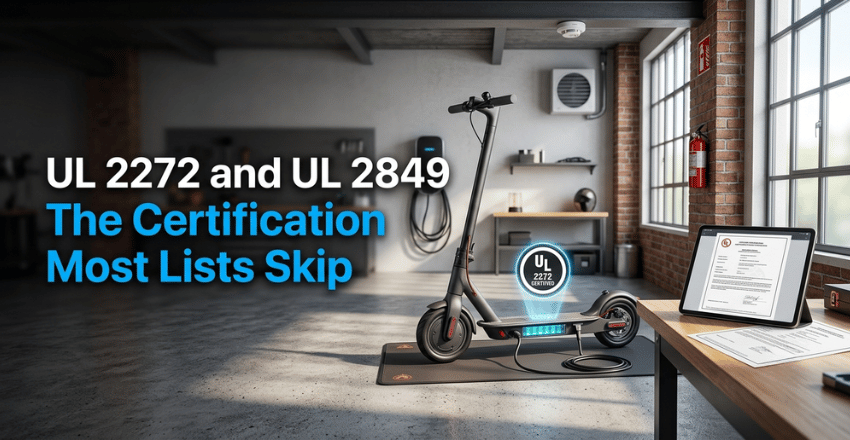
Battery fires, not crashes, are what get e-scooters banned from apartment buildings. UL 2272 is the standard that covers the whole electrical system of a personal e-mobility device, including drop tests and charge abuse. UL 2849 is its equivalent for e-bikes.
New York City mandated these standards in 2023, and fire injury rates there have since slowed. Certification is voluntary elsewhere, so read the product listing: NIU and Segway both publish UL certification on their US models. Charge in the open, not wedged behind the ramps and jack stands in your garage.
Battery care is the same discipline EV drivers practice. Avoid charging to 100% nightly, a habit covered in our Volkswagen ID.4 ownership guide.
Conclusion
The best electric scooters of 2026 aren’t the ones with the biggest numbers on the box—they’re the ones that fit your daily needs. Whether you want a dependable commuter like the Segway Ninebot Max G3, an affordable option such as the Segway Ninebot E3 Pro, a lightweight scooter like the NIU KQi Air, or the long-range EMOVE Cruiser V2, choosing based on real-world performance will lead to a better purchase.
Before you buy, compare tested range instead of advertised claims, verify UL 2272 certification, and check your local riding laws. With the right model, an electric scooter can provide a practical, cost-effective, and enjoyable way to travel every day.
Apart from that, if you want to read more articles like this, then visit the Autovyra automobile category.
FAQs
The Segway Ninebot Max G3 leads for ride quality and brakes, with the NIU KQi 300X as the value choice. Both clear 24 tested miles, which covers a typical round trip with margin.
Expect $500 to $700 for a competent commuter and $1,500 or more for long range or a high weight limit. Anything under $350 usually means weak brakes and an uncertified battery.
Commuter models test between 19 and 28 mph. Most states cap legal speed at 15 to 20 mph regardless of what the machine can do.
California and Maine require a driver’s license. Helmet rules usually apply under age 16 or 18, though Oregon and Massachusetts require one for all riders.
Plan on roughly two-thirds of the advertised figure, and half if you ride fast or on hills. Cold weather cuts it further.