
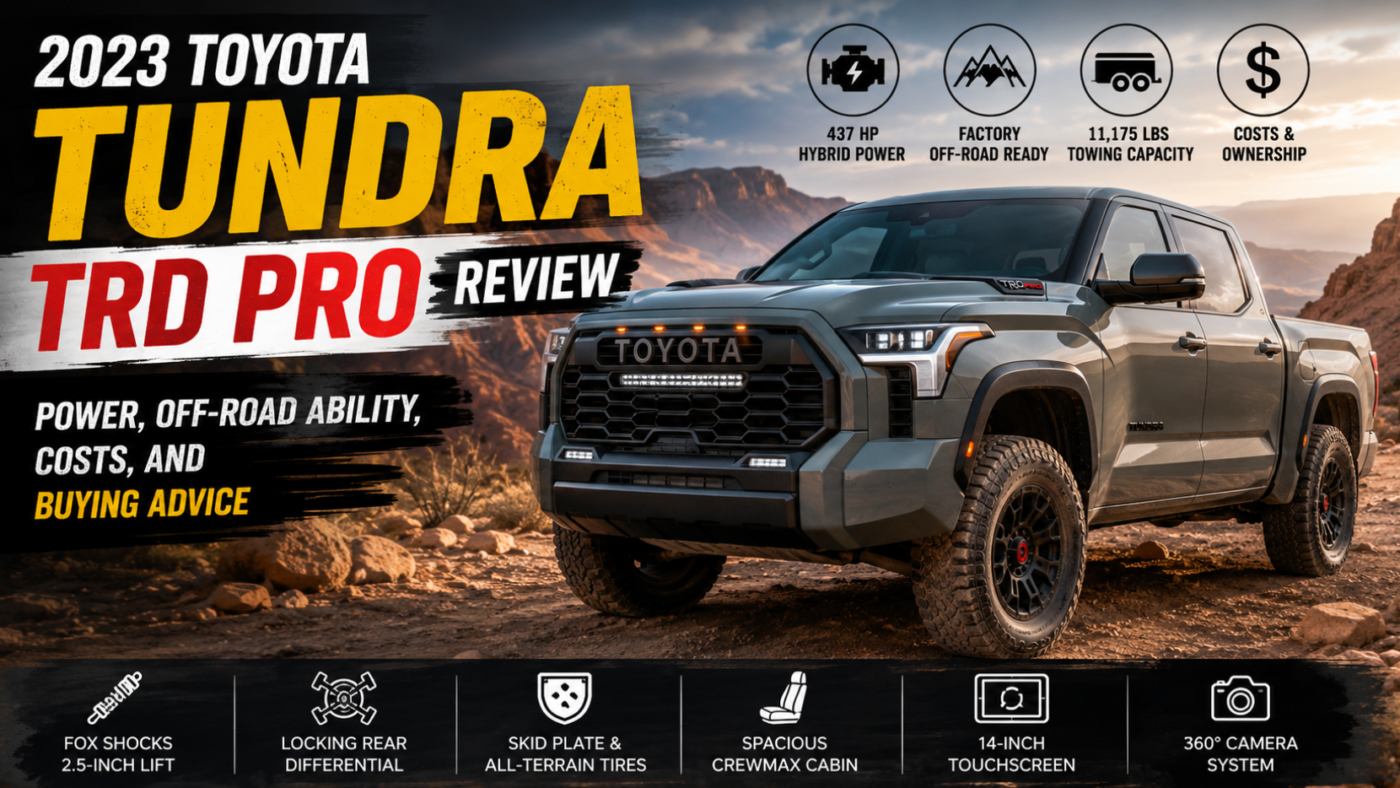
The 2023 Toyota Tundra TRD Pro combines a 437-horsepower hybrid powertrain with specialized FOX suspension, four-wheel drive, and a well-equipped CrewMax cabin. It is quick, comfortable, and capable off-road. Its high purchase price, modest real-world fuel economy, and lower payload than some rivals make it a specialized choice rather than the ideal truck for every buyer.
| Key specification | 2023 TRD Pro |
| Powertrain | Twin-turbo V6 with i-FORCE MAX hybrid system |
| Output | 437 horsepower and 583 lb-ft of torque |
| Transmission | 10-speed automatic |
| Drivetrain | Four-wheel drive |
| Cab and bed | CrewMax cab with 5.5-foot bed |
| EPA fuel economy | 18 city, 20 highway, 19 combined mpg |
| Maximum towing capacity | Up to 11,175 pounds |
| Payload capacity | About 1,600 pounds |
| Original starting price | Approximately $71,000 before options |
| Main off-road equipment | FOX shocks, locking rear differential, skid plate and all-terrain tires |
Toyota made the hybrid i-FORCE MAX powertrain standard on this trim. It pairs a twin-turbocharged V6 with an electric motor to produce 437 horsepower and 583 lb-ft of torque. Toyota also fitted 2.5-inch FOX internal-bypass shocks, a 1.1-inch front lift, an aluminum skid plate and Falken all-terrain tires. For a closer look at this, see 2024 Chrysler Pacifica.
Quick verdict: This truck is a strong choice for drivers who want factory-backed off-road equipment, effortless acceleration and a comfortable full-size cabin. Buyers focused on maximum payload, fuel savings or value may be better served by a lower Tundra trim or a competing pickup.
Key Takeaways
- The hybrid system focuses more on performance than fuel savings.
- Factory off-road hardware reduces the need for immediate modifications.
- Ride comfort is impressive for a large off-road pickup.
- Its short bed and modest payload limit some work-truck uses.
- Used buyers should inspect the truck carefully and check its VIN for open recalls.
- A lower trim with the TRD Off-Road package may offer better value for occasional trail use.
What Makes the 2023 Toyota Tundra TRD Pro Different?
The 2023 Toyota Tundra TRD Pro sits near the top of the Tundra range. It is not a basic pickup with cosmetic decals. Instead, Toyota equips it with meaningful mechanical upgrades designed for rough roads, challenging trails, and loose surfaces.
The front suspension uses FOX internal-bypass shocks and gains 1.1 inches of lift. A locking rear differential helps both rear wheels maintain traction when one side loses grip. Multi-Terrain Select, Crawl Control, and downhill assistance provide extra control at low speeds.
Underbody protection includes a TRD aluminum front skid plate and additional shielding. The truck also receives forged 18-inch BBS wheels wrapped in Falken Wildpeak all-terrain tires. These features make it ready for moderate off-road driving without an immediate trip to an aftermarket shop.
The exterior is intentionally bold. A heritage-style “TOYOTA” grille, integrated light bar, marker lights, black trim and stamped tailgate make this version easy to recognize. Some buyers will love their appearance. Others may find it less discreet than a Platinum or 1794 Edition.
Engine Performance and Driving Experience

The electric motor sits between the engine and the transmission. Its main job is to add torque during acceleration rather than turn the truck into an economy-focused hybrid.
With 583 lb-ft available, the truck moves away from a stop with little effort. Passing power is strong, and the 10-speed automatic keeps the engine within its useful range. The powertrain feels well suited to highway merging, climbing grades, and pulling a trailer.
The hybrid battery occupies space beneath the rear seat. That placement protects the battery but reduces the storage area available inside the cab. Buyers who carry tools or recovery equipment behind the front seats should inspect this area before purchasing.
On pavement, the FOX suspension provides a composed ride for an off-road pickup. Large impacts remain noticeable, yet the truck does not feel loose or uncontrolled. Its size is harder to ignore. Tight parking areas, narrow trails, and city streets require care.
Off-Road Capability
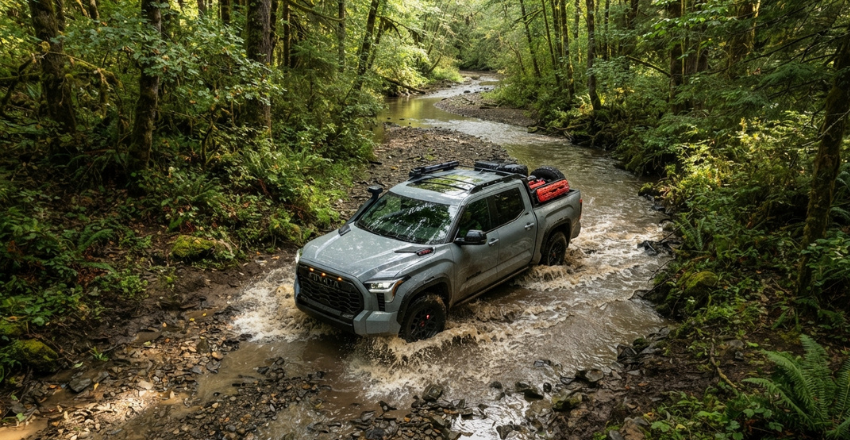
The factory equipment works well together. The suspension adds control over washboard surfaces, while the locking rear differential helps on uneven ground. The skid plate protects vulnerable parts during low-speed trail driving.
Crawl Control can manage throttle and braking at low speeds. This lets the driver focus on steering through rocks, sand, or deep ruts. Multi-Terrain Select adjusts vehicle systems for different surfaces. The truck is still long, wide, and heavy. It cannot match a smaller Tacoma or purpose-built SUV on narrow technical trails. Its running boards and long wheelbase can also reduce clearance over sharp breakover points.
For open desert roads, muddy access tracks, snow, and wide forest trails, the package makes more sense. It offers good control without sacrificing the cabin space expected from a full-size CrewMax truck.
Readers comparing different types of vehicles can browse Autovyra’s automobile guides for broader ownership and model information.
Towing, Payload and Bed Practicality
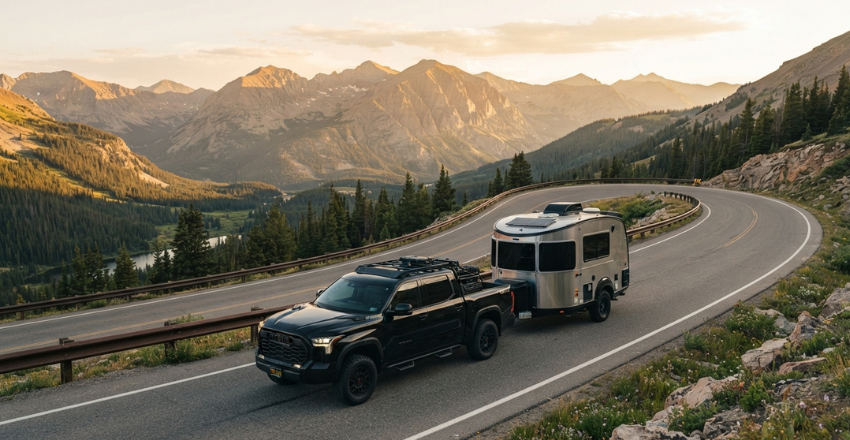
The trim can tow up to 11,175 pounds when properly equipped. Its standard payload capacity is about 1,600 pounds, although the exact figure depends on factory equipment. The driver should always use the payload label on the specific truck rather than relying on a general specification.
Payload matters because passengers, accessories, cargo, and trailer tongue weight all count against it. When using the 2023 Toyota Tundra TRD Pro for towing, a heavy travel trailer may remain below the published towing limit while still pushing the truck close to its payload rating.
The 5.5-foot composite bed works well for camping gear, household supplies, and recreational equipment. It is less convenient for long building materials or large workloads. A bed extender or trailer may be needed for oversized items.
This is one reason the model works better as a recreational tow vehicle than a dedicated commercial hauler. Buyers who tow near the limit should calculate loaded trailer weight, tongue weight, and passenger weight before committing.
Fuel Economy and Running Costs
The EPA rates the 4WD Pro version at 18 mpg in the city, 20 mpg on the highway, and 19 mpg combined. Those figures are reasonable for a powerful full-size pickup, but they are not a dramatic improvement over some non-hybrid trucks.
Real-world results can vary sharply. Motor Trend reported averages between 14 and 16 mpg during part of its long-term test, although the truck achieved 23 mpg during a controlled 526-mile highway trip. Crowdsourced Fuelly data has shown a lower average of near 15 mpg among participating 2023 owners. Driving speed, tires, weather, terrain, and towing have a large effect.
The truck has a 32.2-gallon fuel tank. A full tank can therefore be expensive, even when range is good. Buyers should budget for:
- Fuel and insurance
- Hybrid-specific diagnosis outside warranty
- Replacement all-terrain tires
- Suspension components
- Brake and alignment service
- Higher registration charges in some areas
Autovyra’s vehicle maintenance section can help owners plan routine service and avoid preventable repair costs.
Interior, Technology and Everyday Comfort

The 2023 Toyota Tundra TRD Pro offers a spacious CrewMax cabin with generous passenger room. Adults can sit comfortably in the rear, and the wide interior makes it an excellent choice for family travel. The seating position gives the driver a clear view ahead, although the truck’s tall hood can make nearby obstacles harder to judge.
A large 14-inch touchscreen dominates the dashboard. Wireless smartphone integration, multiple camera views and available premium audio add convenience. The camera system is especially useful when parking or positioning the truck near a trailer.
Materials are durable rather than understated. Red upholstery and camouflage-style trim were available, depending on configuration. The design fits the truck’s character but may not appeal to drivers seeking a luxury-focused cabin.
Wind and tire noise are noticeable on coarse roads. The cabin remains comfortable for long journeys, and the suspension avoids the harsh ride found in some performance-oriented pickups.
2023 TRD Pro vs Other Sensible Choices
| Model or configuration | Best suited to | Main advantage | Main compromise |
| Tundra TRD Pro | Frequent recreation and factory-equipped off-roading | Hybrid torque and complete off-road package | High price and modest payload |
| Tundra Limited with TRD Off-Road package | Daily driving with occasional trails | Better value and a calmer appearance | Less specialized suspension |
| Ford F-150 Raptor | Faster, more aggressive off-road driving | Wider track and greater high-speed capability | Large dimensions and high cost |
| Standard Tundra SR5 4WD | Work, towing and general ownership | Lower purchase price | Fewer trail-focused features |
Pros
- Strong hybrid torque
- Comfortable ride
- Useful factory trail equipment
- Spacious rear seating
- High towing capacity
- Distinctive styling
- Toyota dealer support
Cons
- Expensive when new and still costly used
- Fuel economy may disappoint hybrid shoppers
- Limited under-seat storage
- Short bed
- Lower payload than some rivals
- Large exterior dimensions
- Styling may be too bold for some buyers
Recommendation
Choose the TRD Pro when its suspension, locking differential, skid protection and trail systems will be used regularly. It offers a cohesive factory package with warranty-backed components.
A Limited or SR5 with the TRD Off-Road package is the better value for commuting, towing and occasional trail access. Buyers who want high-speed desert performance should also compare the Ford F-150 Raptor.
Reliability, Recalls and Used-Buyer Checks

A used-truck inspection should go beyond paint condition and mileage. Check the VIN through Toyota and the National Highway Traffic Safety Administration before purchasing. Recall eligibility depends on the individual vehicle, production date, and installed equipment.
Toyota has announced several recalls affecting Tundra and Tundra Hybrid models from this period. Recent campaigns have addressed multimedia or parking-assist software that could interrupt the rearview-camera image. Dealers perform recall repairs without charge.
The widely reported engine-debris recall initially involved certain non-hybrid 2022–2023 trucks with the V35A engine. Buyers should not make assumptions based only on trim or powertrain. A VIN lookup provides the clearest answer for a specific vehicle.
Before buying, inspect or request records for:
- Completed recall work
- Engine oil-change history
- Cooling-system condition
- Hybrid-system warning messages
- Uneven tire wear
- Suspension leaks or damage
- Skid-plate dents and underbody impacts
- Trailer-brake and camera operation
- Aftermarket lifts, tuners or oversized tires
- Accident and flood history
A pre-purchase inspection is especially valuable for a truck that may have been driven off-road. Autovyra’s garage management resources can also help owners organize records, inspections and repair planning.
Is It Worth Buying?
The answer depends on how often you will use its specialist equipment. It makes sense for a buyer who wants a full-size cabin, strong towing ability and real trail hardware in one factory package. The powertrain feels muscular, the ride is controlled, and the interior works well for long trips.
It is harder to justify when the truck will spend almost all its time commuting. A less expensive Tundra can provide similar cabin space, towing usefulness and daily comfort. It may also have a higher payload rating.
Used pricing should be judged against mileage, service history, condition, modifications and local supply. Do not pay a large premium for accessories that reduce reliability or were installed without documentation.
Final Verdict
The 2023 Toyota Tundra TRD Pro model delivers impressive torque, a comfortable cabin and meaningful off-road hardware. It is most convincing as a recreational truck for owners who tow, camp or travel on rough roads.
Its hybrid badge should not be mistaken for economy-car efficiency. The system exists mainly to improve power delivery. Buyers who accept the fuel costs and plan to use the specialist equipment will find a capable, distinctive pickup.
Before purchasing, compare it with a lower Tundra trim, calculate the real payload needed, and check the VIN for outstanding recalls. That process will show whether the premium buys useful capability or features that will rarely leave the pavement.
Apart from that, if you want to know about Honda Passport Review, check out Automobile categories.
Frequently Asked Questions (FAQs)
It produces 437 horsepower and 583 lb.-ft of torque from its twin-turbo V6 hybrid system. Power reaches all four wheels through a 10-speed automatic transmission.
No. It is a conventional hybrid that charges its battery through the engine and regenerative braking. You do not plug it into an external charger.
The EPA rating is 18 mpg city, 20 mpg highway, and 19 mpg combined. Real-world mileage may be lower with aggressive driving, cold weather, heavy accessories, or towing.
The maximum published rating is up to 11,175 pounds when properly configured. Payload, tongue weight, and passenger weight may become the limiting factors before the tow rating is reached.
Yes. An electronic locking rear differential is included to improve traction on loose or uneven surfaces.
Yes, provided you are comfortable with its width, fuel costs and parking requirements. Its spacious cabin and compliant suspension make it easier to live with than its aggressive appearance suggests.
Verify recall completion, service history, tire wear, suspension condition, underbody damage and hybrid warning lights. Arrange an independent inspection and perform a VIN-specific recall search.

