

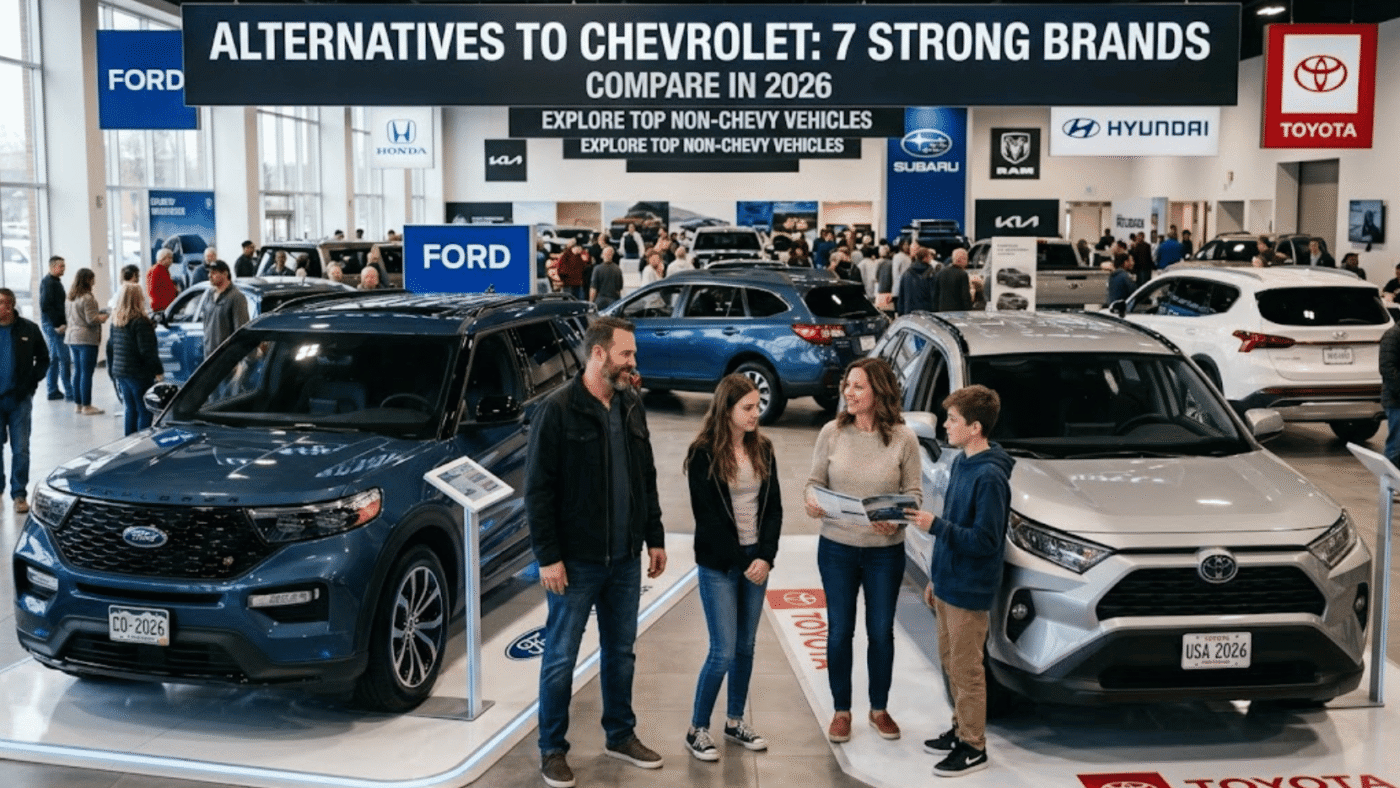
Shopping outside the bowtie badge can reveal vehicles that better fit your priorities. The strongest alternatives to Chevrolet depend on whether you value trucks, hybrids, SUVs, EVs, comfort, or price. Ford, Toyota, GMC, Ram, Honda, Kia, and Hyundai all deserve consideration before you buy. You might also like Challenger vs Charger.
Chevy still covers an unusually broad part of the U.S. market. Its current range includes affordable crossovers, full-size trucks, large SUVs, EVs, and Corvette performance models. That breadth means the right rival changes dramatically by vehicle class.
| Buyer priority | Strong brand to compare | Models worth considering | Main reason |
|---|---|---|---|
| Full-size trucks | Ford | F-150 | Broad truck lineup and powertrain choice |
| Hybrids and efficiency | Toyota | RAV4 Hybrid, Camry, Prius | Strong hybrid selection |
| Premium GM trucks and SUVs | GMC | Sierra, Canyon, Yukon | Upscale alternative within GM |
| Full-size pickup comfort | Ram | Ram 1500 | Strong powertrains and cabin focus |
| Everyday cars and crossovers | Honda | Civic, Accord, CR-V | Practical passenger-car choices |
| Hybrid family vehicles | Kia | Sportage Hybrid, Sorento Hybrid | Broad electrified SUV lineup |
| Value-focused crossovers | Hyundai | Tucson, Santa Fe | Strong SUV and hybrid choices |
Quick answer: Ford is the closest broad-market rival for trucks and SUVs. Toyota and Honda suit shoppers prioritizing efficiency and everyday ownership. GMC offers a more premium GM experience, while Ram targets truck buyers. Kia and Hyundai deserve attention when hybrid SUVs, features, or family value matter more.
1. Ford: The Closest All-Around Rival
Ford should be one of your first stops if you want another major American brand. Its lineup competes directly across trucks, SUVs, performance vehicles, and electric models. Truck shoppers will naturally compare the F-150 with the Silverado.
Ford makes sense when pickup capability or a large SUV matters most. The Expedition, for example, competes directly with the Tahoe in the full-size SUV segment.
Pros
- Strong full-size truck presence.
- Broad SUV selection.
- Several performance-oriented models.
- Direct competitors for many Chevy vehicles.
Cons
- Some comparable vehicles can become expensive with options.
- The ideal choice depends heavily on trim and powertrain.
- Brand preference alone should not replace a model-level comparison.
Ford deserves especially close attention from Silverado, Tahoe, and Traverse shoppers. Compare equivalent trims instead of base prices alone. Equipment packages can quickly change the value calculation.
2. Toyota: A Strong Choice for Hybrids and Everyday Efficiency
Toyota is compelling when fuel economy and electrified choices matter more than traditional American-brand identity. Its hybrid portfolio reaches sedans, crossovers, SUVs, and other everyday vehicles. That gives buyers several ways to reduce fuel use without moving directly to a battery EV.
AutoVyra’s 2025 Toyota Camry guide shows how Toyota has moved its familiar midsize sedan to an all-hybrid lineup. AutoVyra’s 2025 Prius buying guide also covers Toyota’s efficiency-focused hatchback. These models offer useful comparisons for drivers who don’t need a truck or large SUV.
Pros
- Wide hybrid selection.
- Good choices for commuters and families.
- Several efficient crossovers.
- Strong alternatives outside the pickup segment.
Cons
- Buyers wanting V8-style truck character may prefer another brand.
- Some popular hybrids can command strong demand.
- Model availability can vary by region and dealer.
Toyota becomes especially relevant when you are leaving a gas-only vehicle for a hybrid. Its appeal is less about copying Chevy’s lineup. It instead offers a different ownership path centered on efficient powertrains.
3. GMC: Familiar GM Engineering With a More Premium Focus
GMC is the most natural comparison if you like General Motors engineering but want different styling. Its lineup concentrates on trucks and SUVs rather than covering every mainstream body style. Models such as the Sierra, Canyon, and Yukon closely parallel familiar Chevy products.
The distinction is usually positioning rather than an entirely separate engineering philosophy. AutoVyra’s GMC vs. Chevy comparison explains how related models can share platforms and powertrain families. GMC generally emphasizes premium trims, cabin presentation, and upscale utility.
Pros
- Familiar GM mechanical foundations.
- Premium-focused Denali trims.
- Strong truck and SUV selection.
- Easy comparison for Silverado or Tahoe shoppers.
Cons
- Comparable configurations can cost more.
- Fewer low-cost small vehicles.
- No direct Corvette-style performance model.
- Shared engineering may reduce the value of paying extra.
GMC makes the most sense when you already like the basic GM formula. The added cost should buy features you genuinely notice. Compare matching equipment before deciding whether the premium is worthwhile.
4. Ram: A Truck-Focused Alternative for Pickup Buyers
Ram deserves a close look when your shopping list starts with a full-size pickup. The 2026 Ram 1500 offers several engines, including Hurricane six-cylinders and an available HEMI V8. Ram lists a maximum available towing capacity of 11,610 pounds.
That makes Ram more specialized than a broad-brand rival like Ford. It does not replace Chevy across compact SUVs, EVs, or sports cars. It can still be a compelling alternative to the Silverado when pickup comfort and configuration matter most.
Pros
- Strong full-size pickup focus.
- Multiple engine choices.
- High-output Hurricane option.
- Wide range of work and luxury trims.
Cons
- Narrower vehicle range than Chevrolet.
- Not useful for sedan or small-crossover shoppers.
- Maximum ratings depend on exact configuration.
- Higher trims can become expensive.
AutoVyra’s 2025 Ram 1500 guide provides added context on its engines, towing, and trims. Truck buyers should compare payload and towing on the exact configuration. Headline maximums rarely apply to every cab and drivetrain.
5. Honda: A Practical Alternative for Cars and Compact SUVs
Honda makes sense for shoppers who need an everyday car or crossover rather than a heavy-duty vehicle. Models such as the Civic, Accord, and CR-V cover common commuter and family needs. The brand is less comparable when towing or full-size pickups are your priority.
The CR-V Hybrid is especially relevant for drivers considering an efficient compact SUV. AutoVyra’s Best MPG SUV for 2026 comparison identifies it as a practical family-oriented hybrid choice. That gives Equinox shoppers another route when fuel economy matters more than staying within an American brand.
Pros
- Practical sedans and crossovers.
- Hybrid choices for everyday driving.
- Easy-to-understand model range.
- Strong fit for commuters and families.
Cons
- No full-size pickup competitor.
- No direct Tahoe or Suburban equivalent.
- Fewer choices for heavy towing.
- Limited appeal for traditional truck buyers.
Honda works best when your actual needs are simpler than your current vehicle. A buyer leaving a large SUV may discover a compact crossover provides enough room. That change can matter more than switching badges.
6. Kia: A Strong Option for Hybrid and Three-Row Families
Kia has expanded its electrified lineup across hybrids, plug-in hybrids, and full EVs. Current choices include the Sportage Hybrid, Sorento Hybrid, Niro, EV6, and EV9. Kia also lists several electrified family vehicles across different sizes.
The 2026 Sorento Hybrid offers standard third-row seating and an EPA-estimated 37 mpg combined in EX front-wheel-drive. That combination may appeal to families who want three rows without a large, truck-based SUV. Kia lists the Sorento Hybrid from $38,890 before destination and other charges.
Pros
- Broad hybrid and EV range.
- Several family-oriented SUVs.
- Three-row electrified choices.
- Competitive feature content.
Cons
- Not a direct substitute for heavy-duty trucks.
- Towing needs may favor larger body-on-frame vehicles.
- Dealer pricing can differ from MSRP.
- EV suitability still depends on charging access.
Kia is worth comparing when efficiency and passenger space matter equally. Its electrified choices cover more use cases than many shoppers expect. That makes it especially useful for Traverse or Equinox buyers exploring hybrids.
7. Hyundai: A Value-Focused SUV and Hybrid Alternative
Hyundai belongs on the same shortlist when crossovers and hybrid powertrains are priorities. The Tucson and Santa Fe cover popular compact and midsize family-SUV roles. Electrified versions provide another route for drivers trying to reduce gasoline use.
AutoVyra’s plug-in hybrid SUV guide includes the Tucson Plug-in Hybrid among current choices. That model targets buyers who can charge regularly but still want gasoline backup. The format suits households that aren’t ready for a fully electric vehicle.
Pros
- Broad crossover range.
- Hybrid and plug-in hybrid choices.
- Family-oriented vehicle formats.
- Useful alternatives for compact SUV buyers.
Cons
- No direct full-size pickup competitor.
- Charging matters for plug-in hybrid efficiency.
- Not aimed at traditional V8 SUV buyers.
- Exact value depends on trim and incentives.
Hyundai is most relevant when your Chevy shortlist centers on crossovers. It becomes less relevant for Silverado or Corvette buyers. Match the brand to the vehicle class before comparing prices.
How to Choose Among Alternatives to Chevrolet

Start with the vehicle type rather than the brand name. A Silverado buyer should compare Ford, Ram, GMC, and Toyota trucks first. An Equinox shopper should spend more time with crossovers from Toyota, Honda, Kia, Hyundai, and Ford.
Next, define three priorities you will not compromise on. Those priorities might include towing, fuel economy, third-row room, purchase price, or charging access. Testing vehicles against those requirements prevents attractive features from distracting you.
Finally, compare like-for-like configurations. Check drivetrain, safety equipment, towing hardware, seating, destination charges, and dealer pricing. Test-drive finalists on the same day whenever possible.
Our Verdict: Which Brand Should You Compare First?
There is no single replacement that beats Chevy for every buyer. Ford is the broadest alternative, especially for trucks and traditional SUVs. Toyota and Honda make more sense when efficiency and everyday passenger vehicles lead your priorities.
GMC is the logical move when you want familiar GM engineering with more premium positioning. Ram should enter the conversation when a full-size pickup is the main goal. Kia and Hyundai deserve attention for families considering hybrids, plug-in hybrids, and feature-rich crossovers.
The strongest buying strategy is to compare vehicles, not logos. Use the same budget and required equipment across every candidate. Then choose the model that fits your daily driving with the fewest compromises.
Frequently Asked Questions
What are the best alternatives to Chevrolet?
Ford, Toyota, GMC, Ram, Honda, Kia, and Hyundai are strong brands to compare. Each serves different buyers, so there is no universal winner. Start with the brands that compete directly in your preferred vehicle class.
What brand is most similar to Chevy?
Ford is probably the closest broad-market competitor because both sell trucks, SUVs, performance vehicles, and electrified models. GMC is mechanically closer in several segments because both belong to General Motors. GMC has a narrower and more premium-focused range.
What should Silverado buyers compare?
Start with the Ford F-150, Ram 1500, GMC Sierra 1500, and Toyota Tundra. Compare towing and payload using the exact cab, engine, drivetrain, and axle configuration. Maximum advertised figures may not apply to the truck you actually buy.
Which brands are better for hybrid SUVs?
Toyota, Honda, Kia, and Hyundai offer several strong hybrid or electrified SUV choices. Your ideal model depends on size, price, fuel economy, and charging access. AutoVyra’s fuel-efficient SUV comparison can help narrow that shortlist.
Is GMC a good alternative to Chevy?
Yes, especially for truck and SUV shoppers who already like General Motors products. GMC often emphasizes premium styling, interior materials, and upscale trims. Compare equivalent equipment because related vehicles can share important mechanical components.
Before You Buy
Build a shortlist of three vehicles that meet your real requirements. Price those vehicles with equivalent equipment, then test-drive each one. That process will reveal more than comparing badge reputation alone.
For deeper research, AutoVyra’s vehicle guides cover trucks, hybrids, SUVs, EVs, and performance cars. Use those comparisons to narrow the field before visiting dealers. A focused shortlist makes the final buying decision much easier.