

The Subaru Outback 2026 marks one of the model’s biggest changes in years. Subaru has replaced the familiar wagon-like profile with a taller, boxier midsize-SUV design while keeping standard all-wheel drive, useful ground clearance, and two familiar gasoline engines.
For buyers, the redesign is more than cosmetic. The cabin gets new displays, physical climate controls, extra space, upgraded driver assistance, and a simplified six-trim U.S. lineup.
| Key fact | 2026 model |
| U.S. starting MSRP | $34,995 before destination |
| Drivetrain | Standard Symmetrical AWD |
| Base engine | 2.5-liter flat-four, 180 hp |
| Turbo engine | 2.4-liter flat-four, 260 hp |
| Best highway MPG | Up to 31 mpg |
| Standard ground clearance | 8.7 inches |
| Wilderness ground clearance | 9.5 inches |
| Touchscreen | 12.1 inches |
| Seating | Five |
| U.S. trims | Six |
Quick answer: The redesigned Outback becomes more SUV-like without abandoning the traits that built its following. The standard engine favors efficiency, while XT and Wilderness versions add a much stronger turbo engine. Buyers also get updated infotainment, standard AWD, improved safety technology, and more cabin space.
What Changed on the Subaru Outback 2026?
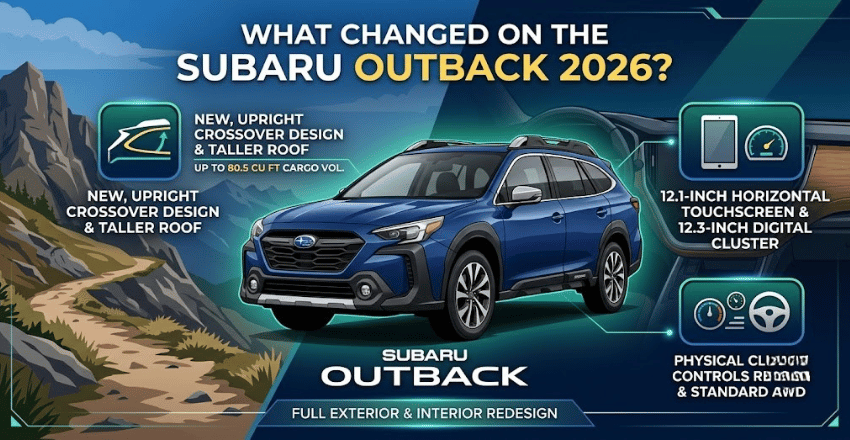
The seventh-generation model receives a full exterior and interior redesign. Its taller roof and more upright body make it look closer to a conventional midsize crossover. That change may divide longtime fans who preferred the low wagon silhouette, but it creates practical benefits inside.
Subaru says the redesigned cabin offers up to 112.3 cubic feet of passenger volume and up to 80.5 cubic feet of maximum cargo volume. The flatter roof also provides additional headroom. Technology changes are equally significant. Every trim gets a new 12.1-inch horizontal touchscreen and a 12.3-inch digital instrument cluster. Wireless Apple CarPlay and Android Auto are standard.
Physical climate controls also return. That addresses a common complaint about the previous vertically oriented touchscreen layout. The redesign keeps the ingredients owners expect: standard Symmetrical All-Wheel Drive, X-MODE, substantial ground clearance, and a horizontally opposed four-cylinder engine.
2026 Outback Price and Trim Comparison
Subaru currently lists six U.S. trims. Published manufacturer prices below are MSRP figures before destination charges, options, taxes, and dealer fees.
| Trim | Starting MSRP | Engine | Highway/city MPG |
| Premium | $34,995 | 2.5L, 180 hp | 31/25 |
| Limited | $41,715 | 2.5L, 180 hp | 31/25 |
| Touring | $45,395 | 2.5L, 180 hp | 31/25 |
| Limited XT | $44,365 | 2.4L turbo, 260 hp | 29/21 |
| Wilderness | $44,995 | 2.4L turbo, 260 hp | 27/21 |
| Touring XT | $47,995 | 2.4L turbo, 260 hp | 29/21 |
The Premium is the value entry point. Limited adds more comfort equipment, while Touring focuses on higher-end features. Limited XT and Touring XT combine upscale equipment with the turbocharged engine. Wilderness uses the same 260-hp engine but adds equipment intended for rougher terrain. That creates a useful decision point. You don’t need the most expensive version to get more power.
Two Engines: Which One Should You Choose?
The standard 2.5-liter four-cylinder produces 180 horsepower. It works with a continuously variable automatic transmission and standard AWD. This engine makes sense when fuel economy and purchase price matter more than quick acceleration. Subaru rates non-turbo versions at up to 25 mpg city and 31 mpg highway.
Independent testing has found the base powertrain less energetic than the turbo option. Car and Driver estimates an 8.8-second 0–60 mph time for the naturally aspirated version. The available 2.4-liter turbo produces 260 horsepower and 277 lb-ft of torque. It is offered in XT models and comes standard in Wilderness.
Car and Driver recorded 0–60 mph in 6.2 seconds for a Touring XT and 6.0 seconds for Wilderness. That is a substantial performance difference. The turbo is also the better match for frequent towing. Published ratings reach 3,500 pounds with the turbo versus 2,700 pounds with the standard engine.
For most commuters, the 2.5-liter should cover daily needs. Buyers carrying heavier loads, merging frequently at highway speeds, or towing will have stronger reasons to choose an XT.
Interior and Technology Improve Where It Matters
The old portrait-style infotainment screen is gone. Its replacement is a 12.1-inch horizontal display paired with a standard 12.3-inch digital instrument cluster. The new layout also places key climate functions on physical controls.
That change should make common adjustments easier while driving. Wireless smartphone integration comes standard, so Apple CarPlay and Android Auto don’t require a cable. Subaru has also redesigned the multimedia software and processor.
Passenger space benefits from the taller body. The squared roof provides extra vertical room, especially for rear-seat occupants. Cargo practicality remains one of the model’s main strengths. That makes the vehicle relevant for families, pets, road trips, camping equipment, and winter gear.
Buyers comparing practical SUVs can also read AutoVyra’s Best MPG SUV for 2026 guide to see how fuel-efficient crossover alternatives compare.
Safety and Hands-Free Driving Features
Every version includes an upgraded EyeSight driver-assistance package. Standard technologies include pre-collision braking and adaptive cruise control with lane centering. Subaru also offers newer assistance features on selected trims. Hands-Free Assist is standard on Touring and Touring XT. Subaru says it can provide automated steering assistance on most interstate highways when operating conditions are satisfied.
It does not make the vehicle autonomous. The driver must remain attentive and monitor the road. Another available feature, Emergency Stop Assist with Safe Lane Selection, can react when the system detects an incapacitated driver. It can steer toward the shoulder, stop the vehicle, and activate the hazard lights. These systems add convenience, but buyers should understand their operating limits before relying on them.
Is Wilderness Worth the Extra Money?
Wilderness is aimed at drivers who intend to use the vehicle beyond normal pavement. Its upgrades include 9.5 inches of ground clearance, all-terrain tires, dual-function X-MODE, protective exterior elements, and the 260-hp turbo engine.
For 2026, adaptive dampers are another major addition. Independent road tests have found that they help control body movement while preserving trail capability.
Wilderness pros
- 260-hp turbo engine comes standard
- 9.5 inches of ground clearance
- All-terrain tires
- Dual-function X-MODE
- Adaptive dampers
- 3,500-pound towing rating
Wilderness cons
- Lower fuel economy than non-turbo trims
- Costs substantially more than Premium
- Trail hardware may be unnecessary for pavement-focused owners
Wilderness is the strongest choice for frequent dirt roads, rough trails, snow, or outdoor trips. An XT trim may make more sense when you want the turbo engine without the full off-road package.
Fuel Economy: Good for AWD, but There’s No Hybrid
Non-turbo versions achieve the strongest published efficiency at 25 mpg city and 31 mpg highway. XT trims drop to 21 mpg city and 29 mpg highway. Wilderness is rated at 21 mpg city and 27 mpg highway. Those figures are respectable for a standard-AWD vehicle of this size, but shoppers prioritizing fuel savings have hybrid alternatives.
There is no U.S. Outback hybrid for the 2026 model year. Reports have suggested Subaru could add one in a later model year, but buyers should treat future-product predictions as speculation until Subaru confirms them. That distinction matters because several competing crossovers already offer hybrid powertrains.
Which 2026 Trim Is the Best Buy?
Premium is the value pick for buyers who want the redesign, AWD, large screens, and core safety equipment without spending above $40,000 before destination. Limited suits buyers who prioritize cabin comfort and added equipment but don’t need the turbo engine.
Limited XT is arguably the interesting middle ground. Its price is close to Wilderness, yet it combines more power with a road-focused configuration. Touring targets shoppers looking for upscale features without turbo performance. Touring XT combines the richest equipment level with the stronger engine.
Wilderness makes the clearest case when off-pavement capability is part of your actual routine. The right trim depends more on how you drive than on which badge sits highest in the lineup.
Is the 2026 Model Worth Buying?
The redesign improves several practical areas. Cabin technology is newer, the interior is roomier, physical climate controls are back, and driver-assistance features have expanded.
The biggest question is styling.
Previous generations occupied an unusual space between a wagon and an SUV. The new model moves closer to the conventional crossover shape. That may attract buyers who previously dismissed the vehicle as a wagon. It could also disappoint owners who valued its distinctive proportions.
Mechanically, there is less of a revolution. Both engine choices are familiar, and AWD remains standard. Our verdict: the redesign is most compelling for buyers who value space, AWD capability, comfort, and practical technology more than sporty handling or maximum fuel economy. Test-drive both engines before choosing. Their performance difference is large enough to affect the ownership experience.
Final Takeaway
The redesigned 2026 model makes a clear shift toward the mainstream midsize-SUV market while preserving the AWD capability that defines the nameplate. Premium offers the strongest value. XT trims make sense when performance matters, while Wilderness remains the specialist choice for rougher terrain.
Before buying, compare the exact trim’s equipment, drive both engines, check current dealer pricing, and calculate fuel and insurance costs. Those factors will tell you more than choosing a trim from its specification sheet alone.
If you want to know about 2025 Subaru Outback Review then visit our Automobile category.
Frequently Asked Questions
Subaru lists the Premium at $34,995 before destination, options, taxes, and fees. Current manufacturer pricing reaches $47,995 for Touring XT before those additional costs.
Yes. Limited XT, Touring XT, and Wilderness use a 2.4-liter turbocharged four-cylinder producing 260 horsepower and 277 lb-ft of torque.
Yes. Symmetrical All-Wheel Drive is standard across the lineup.
Non-turbo versions are rated at up to 25 mpg city and 31 mpg highway. XT models reach 21/29 mpg, while Wilderness is rated at 21/27 mpg.
Standard versions provide 8.7 inches. Wilderness increases clearance to 9.5 inches.
No U.S. hybrid version is currently offered for the 2026 model year.
Choose an XT when stronger road performance is the main goal. Wilderness is better suited to buyers who also need extra clearance, all-terrain tires, adaptive dampers, and additional off-road equipment.