

The Honda Prelude 2026 brings a familiar name back as a modern two-door hybrid rather than a traditional high-revving sports coupe. It combines a 200-horsepower electrified powertrain with chassis hardware influenced by the Civic Type R, while prioritizing fuel economy, comfort, and everyday usability.
Quick answer: The new Prelude is a front-wheel-drive hybrid coupe with 200 horsepower, an EPA-rated 44 mpg combined, adaptive dampers, Brembo front brakes, and Honda S+ Shift. Pricing starts at $42,000 before destination. It suits drivers who value sharp handling and efficiency more than maximum acceleration or a manual gearbox.
| Specification | Model |
| Starting MSRP | $42,000 before destination |
| Power | 200 hp |
| Torque | 232 lb-ft |
| Powertrain | 2.0-liter four-cylinder hybrid |
| Drivetrain | Front-wheel drive |
| EPA fuel economy | 46 city / 41 highway / 44 combined mpg |
| Tested 0–60 mph | Approximately 6.4–6.5 seconds |
| Wheels | 19-inch alloy wheels |
| Seating capacity | 4 passengers |
| Cargo capacity | 15.1 cu. ft. |
| Available trims | Hybrid and Hybrid Two-Tone |
Honda currently charges a $1,195 destination fee, which puts the standard car at $43,195 before tax, registration, accessories, and dealer adjustments. The Two-Tone version starts at $42,500 before destination and applicable paint charges. 026 specs and key facts
Under the hood is a 2.0-liter four-cylinder engine working with Honda’s two-motor hybrid system. Total system output is 200 horsepower, while published specifications list 232 lb-ft of torque.
This is not a conventional automatic or dual-clutch setup. Honda uses its hybrid direct-drive arrangement and adds S+ Shift, which simulates stepped gear changes through paddle inputs, sound, and changes in power delivery.
Honda also gives the coupe hardware that goes beyond the regular Civic Hybrid. Standard equipment includes adaptive dampers and four-piston Brembo front brake calipers. Four drive modes are available: Comfort, GT, Sport, and Individual—nNusualformula. Rather than chasing the highest horsepower figure, the car combines an efficient hybrid drivetrain with chassis equipment designed to make corners more interesting.
How Fast Is the Honda Prelude 2026?
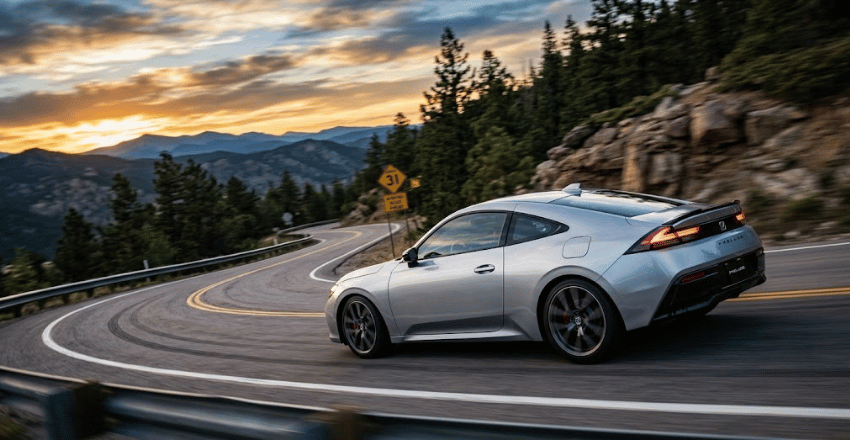
Independent testing gives a clearer picture than horsepower alone. Car and Driver recorded 0–60 mph in 6.5 seconds, while MotorTrend achieved 6.4 seconds in its testing. Those figures make the coupe quick enough for daily driving but place it behind several dedicated sports cars in straight-line acceleration. That matters for buyers expecting a Civic Type R in sleeker clothing. It isn’t one.
The stronger argument for this car is its chassis. Reviewers have consistently praised its cornering behavior, stability, and front-end response. Type R-derived suspension concepts, adaptive dampers, and strong brakes give it more handling focus than its modest power figure suggests. Drivers whose priority is acceleration may find better value elsewhere. Drivers who enjoy winding roads but still want quiet commuting and strong fuel economy may see the package differently.
Fuel economy is one of its strongest advantages.
Honda rates the coupe at 46 mpg city, 41 mpg highway, and 44 mpg combined. That is an unusual efficiency figure for a car with sports-coupe styling and 200 horsepower. The tank also helps give the car useful driving range without requiring charging. This is a conventional hybrid, not a plug-in hybrid or battery-electric vehicle.
For shoppers placing fuel use ahead of body style, AutoVyra’s guide to the most fuel-efficient SUVs for 2026 offers useful context across other hybrid options. The key trade-off is clear: Honda sacrificed some outright performance to combine responsive road manners with economy-car-like fuel consumption.
Interior, technology, and everyday practicality
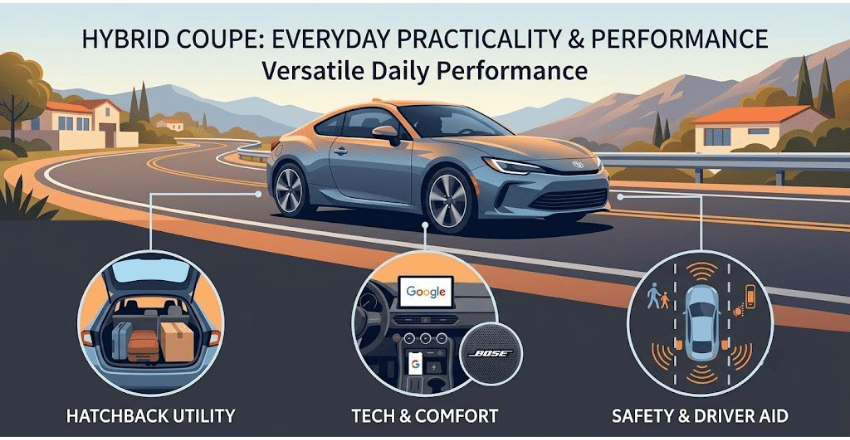
The cabin makes a stronger case for the price than the horsepower number alone. Standard technology includes a 9-inch touchscreen with Google built-in, wireless Apple CarPlay and Android Auto, wireless phone charging, a Wi-Fi hotspot, and Bose premium audio. Heated leather-trimmed front sport seats and dual-zone climate control are also included. split-folding rear seat, and the liftback layout creates more cargo flexibility than the exterior shape suggests. Edmunds lists cargo capacity at 15.1 cubic feet.
The rear seats are better viewed as occasional seating than as a substitute for a four-door sedan. For two people, though, the hatch and folding seatbacks make weekend luggage or larger purchases easier to carry. Honda Sensing driver-assistance equipment includes adaptive safety systems alongside blind-spot monitoring, rear cross-traffic monitoring, parking sensors, and low-speed braking control. Make sense?
Price is probably the biggest issue facing the revived coupe. At $43,195 including destination for the standard version, it overlaps with cars that provide more straight-line performance. Edmunds currently lists lower starting prices for the Toyota GR86 and Subaru BRZ, two rear-wheel-drive coupes built around a more traditional sports-car formula. It has features those cars don’t emphasize to the same degree: 44-mpg combined efficiency, standard hybrid power, a well-equipped cabin, strong hatchback utility, and a more relaxed daily-driving character.
So the comparison depends on what you want.
Choose a conventional sports coupe when rear-wheel drive, a manual transmission, and driver involvement are your priorities. Consider this hybrid when you want one car to handle commuting, traffic, weekend roads, and longer trips without poor fuel economy.
Readers interested in the opposite extreme of performance can compare the approach with AutoVyra’s C8 Corvette ZR1 performance guide. For an analog example from an earlier era, the 1999 Saleen S351 guide shows how dramatically the definition of a performance coupe has changed.
What the S+ Shift system does
There is no manual transmission. S+ Shift is Honda’s attempt to give the hybrid drivetrain some of the rhythm drivers associate with a geared transmission. Paddle inputs, simulated engine-speed changes, and programmed shift sensations create an eight-step experience without adding a conventional gearbox.
Whether that works for you will be personal. It adds interaction compared with a normal hybrid drive mode, but it doesn’t turn the car into a manual. That makes a test drive especially important. Buyers familiar with older generations may have different expectations from shoppers coming from a modern hybrid sedan.
Pros and cons
Pros
- EPA-rated 44 mpg combined
- Sharp, stable handling
- 200-hp hybrid system with strong low-speed response
- Adaptive dampers and Brembo front brakes
- Practical liftback cargo area
- Well-equipped cabin and infotainment
- Distinctive two-door styling
Cons
- High price relative to its acceleration
- No manual transmission
- Front-wheel drive only
- Rear seat is tight
- S+ Shift cannot fully recreate a conventional gearbox
- Enthusiasts expecting Type R performance may be disappointed
Buyer verdict: Who should get one?

The revived Honda Prelude works best as a sporty grand tourer and daily driver rather than a stripped-down performance car. Its combination of hybrid fuel economy, hatchback practicality, strong chassis tuning, and standard technology is rare. The 200-hp output looks modest for a coupe above $40,000, but the rest of the package explains where much of the money goes.
Our verdict: Consider it when you want a stylish, efficient two-door that can commute comfortably and still feel composed on a winding road. Skip it when acceleration, rear-wheel drive, or a manual transmission ranks above efficiency and daily usability. Before deciding, compare the actual dealer price rather than MSRP alone and take a meaningful test drive in more than one drive mode. AutoVyra’s broader Automobile guides can also help you compare other performance, efficiency, and ownership options.
If you want to know about Plug-In Hybrid SUV Buying Guide 2026 then visit our Automobile category.
Frequently asked questions
Yes. It uses a 2.0-liter gasoline engine and a two-motor hybrid system producing 200 horsepower. It doesn’t need to be plugged in.
Honda lists a starting MSRP of $42,000 before a $1,195 destination charge. That makes the standard vehicle $43,195 before taxes, registration, accessories, or dealer adjustments.
It can be for drivers who value efficiency, handling, design, equipment, and daily comfort. Buyers focused mainly on horsepower per dollar have less expensive sports-car alternatives worth comparing first.